

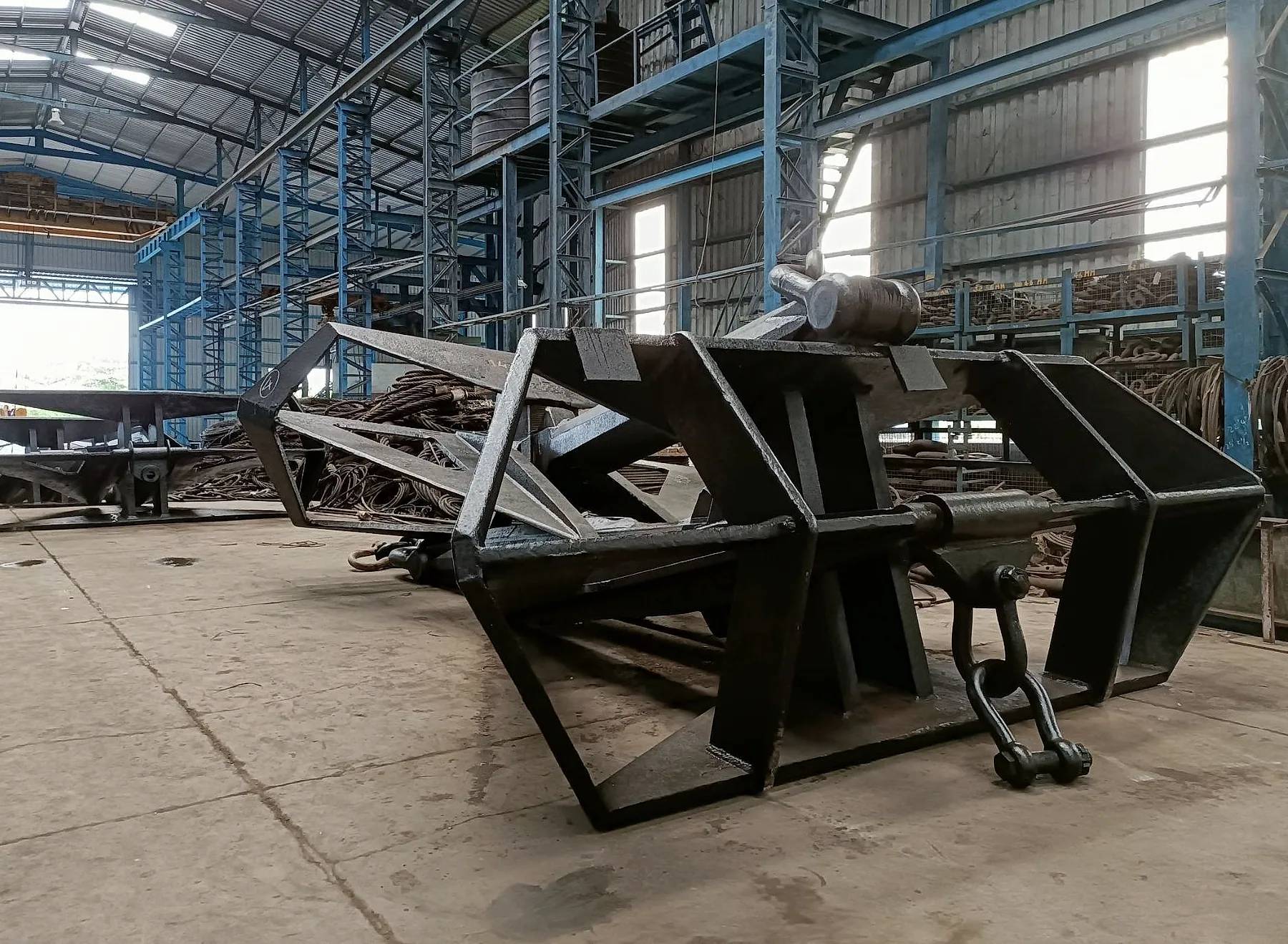
Anchors · Anchor chain · Accessories
Ship Anchors and Anchor Chain Supplier, India
Sealinkers has traded ship anchors and anchor chain out of Darukhana, Mumbai since 1977. This is the whole outfit: anchor, end shackle, swivel, cable and joining shackles, with every dimension and every proof and breaking load published in full, and the certification an Indian buyer should ask for set out plainly.
Safety is not expensive, it’s priceless.
The cable, from the anchor outboard
An anchoring outfit is one system sized off one number. Get the chain diameter right and everything else follows from it — which is exactly why the tables on this site are generated from that diameter rather than copied out of a catalogue.
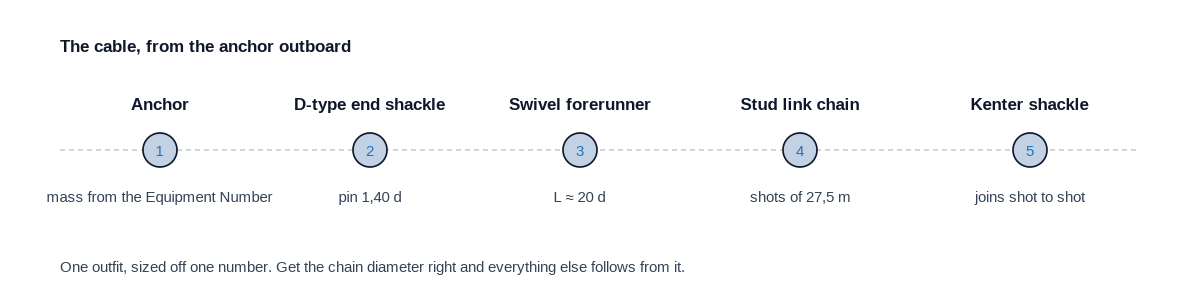
Swipe sideways to follow the cable from the anchor to the chain locker.
- 1
Anchor
Mass from the Equipment Number
- 2
D-type end shackle
Pin 1.4 × chain diameter
- 3
Swivel forerunner
Sheds turns from the cable
- 4
Stud link chain
Shots of 27.5 m
- 5
Kenter shackles
Join shot to shot
The whole range in one document: the Sealinkers anchor and anchor chain catalogue
Size the whole cable from one diameter
Replacing a shot, or a single fitting? The diameter and grade stamped on your end link is the entire specification. Everything that has to match it is below.
Match a cable by diameter
Enter the diameter and grade stamped on your end link. Everything that has to fit it follows.
- Link length L
- 456 mm
- Pitch P
- 304 mm
- Width W
- 273.6 mm
- Stud width
- 98.8 mm
- Length L1
- 456 mm
- Pitch P4
- 304 mm
- Width W4
- 319.2 mm
- Stud/pin K
- 115.5 mm
- Pin diameter d5
- 106.4 mm
- Length L5
- 661.2 mm
- Inside length P5
- 349.6 mm
- Width W5
- 395.2 mm
- Overall length L
- 1523.8 mm
Dimensions are the ISO 1704 proportions of the nominal diameter; loads are computed from the IACS UR W18 form. Accessories are proof-tested at the load of the chain they serve, which is why one set of load figures covers the shackles and the swivel as well as the chain. Mass is an estimate for planning — use the figure on the works certificate for anything contractual.
The range
Ship anchors
Stockless bower anchors — the plain Hall pattern, the Spek, and high-holding-power designs that earn a 25 % mass reduction.
Hall anchor
Hall type stockless bower anchors, 180 kg to 46,000 kg, supplied from Mumbai. Standard mass series, fluke angle, and the certificates to ask for.
180–46,000 kg standard mass series
Spek anchor
Spek type stockless bower anchor: broad crown, slender flukes, 40° fluke angle. How it differs from a Hall, and why high holding power must be read off the certificate.
40° ± 1° fluke angle
AC-14 HHP anchor
AC-14 pattern high holding power bower anchor: what the HHP approval actually requires, the 25% mass reduction it earns, and the certificates to ask for.
75 % of ordinary stockless mass
Other HHP patterns
Fully balanced and plate-built delta fluke high holding power anchors: what the geometry does, where each is specified, and why the dimensions come on enquiry.
35°–40° typical fluke angle
Anchor & mooring chain
Stud link anchor chain cable in Grades U2 and U3, and offshore mooring chain in the R3–R5 ladder.
Stud link anchor chain
Stud link anchor chain 12.5–162 mm, Grades U2 and U3, supplied from Mumbai. Proof and breaking loads, link sizes, IS 4484 and the certificates to ask for.
12.5–162 mm diameter range
Offshore mooring chain
Offshore mooring chain 64–185 mm in Grades R3, R3S, R4, R4S and R5: stud and studless proof and breaking loads, and why it is not ship anchor chain.
64–185 mm diameter range
Chain accessories
The fittings that make up a cable: Kenter joining shackles, D-type anchor end shackles and swivel forerunners.
Kenter joining shackle
Kenter joining shackles 12.5–162 mm: dimensions, proof and breaking loads by chain grade, how the lead-plug pin works, and the batch test certificate to ask for.
12.5–162 mm chain diameter range
D type anchor shackle
D type anchor end shackles 12.5–162 mm: pin diameter, bow and length dimensions, proof and breaking loads by chain grade, and the certificates required.
12.5–162 mm chain diameter range
Swivel forerunner
Anchor swivel forerunner assemblies 12.5–162 mm: overall length by chain diameter, proof and breaking loads by grade, and what the assembly contains.
12.5–162 mm chain diameter range
Buying anchors and anchor chain from us
Send one enquiry for the whole outfit. To quote, we need:
- The vessel’s Equipment Number, or the anchor pattern and mass
- Chain diameter, grade and the number of 27.5 m shots
- Kenter shackles, end shackles and swivels, if you want them matched to the chain
- The class the vessel is built or surveyed to
- The port or yard for delivery, and the date you need it
We confirm availability, lead time and the certificate package with the quote.
Request a quoteIndian and international standards
In India, stud link anchor chain with its connecting shackles and swivels is covered by IS 4484:2013, and ISO 1704:2022 is the international standard. BIS lists IS 3268:1981, the old Indian Standard for stockless anchors, as withdrawn with no replacement, so ship anchors are bought against the rules of the vessel’s class society.
The paperwork is the product
In India the commercial gate on anchors and chain is class, and for most Indian-flag tonnage that means IRS — the country’s own IACS member society, and a Recognised Organisation for DG Shipping. Chain cables and accessories may only be made by works a society has approved, every 27.5 m length is proof-loaded in front of a surveyor, and a three-link sample from every fourth length is broken.
Tell us the class your vessel is being built or surveyed to and we will quote against it, with the certificates that class requires. If you are replacing a shot of chain or a single accessory, send us the diameter and the grade stamped on the end link and we will match it.
What to demand, and what is usually missingWorks approval
Of the manufacturing works itself, typically valid five years. Increasingly asked for as a bidder-eligibility document.
Works test certificate
Chemistry including total aluminium, heat treatment, mechanical and impact results, traceable heat numbers.
Proof-load certificate
Every 27.5 m length of chain, every accessory, every anchor — surveyor-witnessed.
Breaking-load certificate
Batch-based: one three-link sample per four lengths, one accessory per 25, one Kenter per 50. This is the one that is usually missing.
Class certificate
Ties all of the above to the grade, certificate number and society stamp marked on the end links.
Where these numbers come from
Every dimension and every load on this site is computed, not copied. Chain and accessory loads come from the IACS form P = k · d² (44 − 0,08 d) in kN, with the published coefficient for each grade. Dimensions are the ISO 1704 proportions of the nominal diameter — a stud link is 6 d long, 4 d in pitch and 3.6 d across, and every fitting is proportioned the same way. That is what makes chain and accessories from different works interchangeable over the same cable lifter.
Two things are deliberately absent. There is no anchor proof-load table, because those loads come from a stepped class table we do not reproduce — the figure for your anchor is on its certificate. And chain mass is published as an estimate, clearly labelled: the constant varies with a maker’s actual link geometry, so a computed mass table would look authoritative and be wrong by a couple of per cent. Use the works certificate for anything contractual.
60 chain sizes · 41 offshore sizes · 67 anchor masses, every value checked against the published class formula before it ships.
Anchors and anchor chain — questions we get asked
The Equipment Number, or the anchor pattern and mass, plus chain diameter, grade, number of shots, the vessel’s class and the delivery port. For a replacement shot, send the marking stamped on the end link and we will match it.
A supplier. We have traded anchors and chain out of Mumbai since 1977, and we quote against the class your vessel is built or surveyed to, with the works and test certificates that class requires.
From the Equipment Number, calculated from the vessel’s displacement, the profile area above the waterline and the effective height of the deckhouses. That single figure indexes a class table giving the number of anchors, the mass of each, the chain diameter, the chain grade and the total length of cable. Send us the Equipment Number, or the vessel particulars, and we will work it through with you.
27.5 metres. That is the standard shot or shackle length in which chain is manufactured, proof-tested and certified, and shots are joined by Kenter shackles that pass over the windlass cable lifter. A vessel typically carries ten to twelve shots per side, so roughly 275 to 330 metres of cable on each anchor.
Steel, heat treatment and therefore strength at the same diameter. U2 is special quality at 490–690 N/mm² with 27 J impact energy at 0 °C; U3 is extra special quality at 690 and above with 60 J, and is always heat-treated. U3’s breaking load at a given diameter is about 1.43 times U2’s, so it lets you carry a smaller and lighter cable for the same duty. A third grade, U1, exists in mild steel for low Equipment Numbers; we do not tabulate it, but ask if you need it.
The class certificate issued by the surveyor, tying the works and test results to the grade, certificate number and society stamp physically marked on the end links. The one most often missing is the breaking-load certificate: it is batch-based — one three-link sample per four lengths — so a seller who cannot identify the batch cannot produce it.
Tell us the class your vessel is being built or surveyed to and we will quote against it, with the certificates that class requires. If you are replacing a shot of chain or a single accessory, the diameter and the grade stamped on the end link is all we need to match it.
No. They are separate product families under separate class requirements, approved separately. A works approval for Grade U3 ship anchor chain does not entitle a maker to supply Grade R4 mooring chain, and the R grades carry metallurgical, hydrogen-embrittlement and non-destructive examination requirements that ship chain does not.
Tell us the diameter.
The diameter and grade stamped on your end link, or the vessel’s Equipment Number if you are starting from scratch. We will come back with availability and the certification package.
Request a quote