
Reference
Class Certification for Anchors and Anchor Chain in India
In India the commercial gate on anchors and chain is class, and for most Indian-flag tonnage that means IRS. This page sets out what the classification requirements actually demand, which certificates exist, and which of them is the one usually missing.
What IACS is, and why it decides this
The International Association of Classification Societies is the body whose members’ rules cover the great majority of the world’s cargo-carrying tonnage. Its Unified Requirements are the common floor its members apply, so a certificate from any member society means the same technical thing. Its full members include ABS, Bureau Veritas, CCS, CRS, DNV, the Indian Register of Shipping, Korean Register, Lloyd’s Register, ClassNK, PRS, RINA and Türk Loydu.
Why IRS dominates Indian work
The Indian Register of Shipping was founded in Mumbai in 1975, became an IACS associate member in 1991 and a full member in 2010 — India’s only IACS member society. It matters commercially for reasons beyond that membership:
- It is a Recognised Organisation for the Directorate General of Shipping, carrying out statutory surveys on Indian ships.
- It holds several sole delegations for Indian-flag tonnage — load line assignment since 1997, ISM audits since 1998, and ISPS since 2004.
- It has surveyors in Indian yards and at Indian steel and forging works, which is what actually determines whether a works approval and a product survey can be arranged without importing a surveyor.
- It publishes rules for Indian naval ships, so defence and PSU-yard work tends to default to it.
For an Indian shipyard, port trust, dredging company or naval programme, “class = IRS” is the path of least resistance. It is not the only acceptable answer — an ABS, LR, BV or DNV certificate is equally an IACS certificate — but it is the one that will not generate questions.
What certification actually involves
Three layers, and buyers routinely conflate them:
- Works approval. Anchor chain cables and accessories may only be manufactured by works the society has approved. The society reviews the process documentation, agrees a test programme, witnesses approval tests at the works, then issues a certificate of works approval — typically valid five years, with the manufacturer listed publicly. For Grades U2 and U3, the bar itself must come from a society-approved steel mill. Increasingly Indian tenders ask for this as a bidder-eligibility document rather than per consignment.
- Material certification. Cast or heat certificates naming specification, grade, process, heat treatment, chemistry — including total aluminium for chain steel — mechanical results and traceable heat numbers.
- Product survey. The surveyor witnesses the proof load on every 27.5 m length, the break test on the three-link sample representing each group of four lengths, the mechanical and impact tests, the dimensional checks and the weld inspection — then the marking is stamped and the certificate issued. For anchors: material and weld or casting checks, the proof load, a post-proof crack examination and a free head-rotation check, plus the type approval where high holding power is claimed.
The five documents to ask for — and the one that is usually missing
- Works test certificate — chemistry, heat treatment, mechanical and impact results, dimensions, traceable heat numbers.
- Proof-load certificate — every length of chain, every accessory, every anchor.
- Breaking-load certificate — this is the one. It is batch-based: one three-link sample per four lengths of chain, one accessory per batch of 25, one Kenter per batch of 50. A seller who cannot show which batch your goods came from cannot produce it. It is the single most reliable test of whether chain offered as certified actually is.
- Class certificate — the surveyor-issued document tying all of the above to the marking stamped on the end links and accessories. This is what an Indian tender means when it says “class approved test certificate”. A works certificate is not this.
- Works approval certificate of the manufacturer, valid five years.
Where DG Shipping fits
DG Shipping does not certify anchors or chain as products. It authorises classification societies as Recognised Organisations to survey Indian ships and issue statutory certificates; your anchor and chain paperwork is then consumed inside those surveys — the newbuild construction survey, the load line survey, and the drydock survey where the cable is ranged and gauged and links are condemned at 12 % mean diameter loss. So class is the commercial gate and DG Shipping is the flag authority whose statutory certificate the class documentation ultimately supports.
How the buying usually works at Indian yards
Worth knowing before you tender: at Indian public-sector yards, anchors and chain with fittings are frequently bought as a limited tender against an owner- or class-approved maker list rather than on open specification. Getting onto that list matters more than the quoted price. If you are specifying, say so early; if you are buying, ask whether a maker list applies before you build the enquiry.
What we do
Tell us the class your vessel is being built or surveyed to and we will quote against it, with the certificates that class requires. If you are replacing a shot of chain or a single accessory, send us the diameter and the grade stamped on the end link and we will match it.
Frequently asked questions
Is IRS certification the same as IACS certification?
IRS is a full member of IACS, so an IRS certificate is an IACS-member certificate and carries the same Unified Requirements behind it. "IACS certified" is not a certificate in itself — there is always a named society. In India IRS is usually the practical answer because it is the domestic member with surveyors in Indian yards and works, and is a Recognised Organisation for DG Shipping.
Which certificate proves anchor chain is genuinely class approved?
The class certificate issued by the surveyor, tying the works and test results to the grade, certificate number and society stamp physically marked on the end links. A manufacturer’s works certificate on its own is not it. The hardest one to fake is the breaking-load certificate, because it is batch-based — one three-link sample per four lengths — and a reseller has to be able to show which batch your chain belongs to.
Does DG Shipping certify anchors and chain?
No. DG Shipping authorises classification societies as Recognised Organisations to survey Indian ships and issue statutory certificates. The anchor and chain documentation is consumed inside those surveys — construction, load line, and the drydock survey where the cable is gauged. Class is the commercial gate; DG Shipping is the flag authority behind it.
What is a works approval and do I need to see it?
It is the society’s approval of the manufacturing works itself — process review, agreed test programme, witnessed approval tests, then a certificate typically valid five years. Chain cables and accessories may only be made by approved works. Indian tenders increasingly ask for it as a bidder-eligibility document, so it is worth requesting up front rather than at delivery.
Can a Grade U3 approval cover offshore R4 chain?
No. Ship anchor chain and offshore mooring chain are separate product families under separate requirements, and offshore grades are approved individually — an R3 approval does not even automatically confer R3S. A works approved for U3 ship chain has to be approved again, separately, for any R grade.
Related
 Anchor chain
Stud link anchor chain
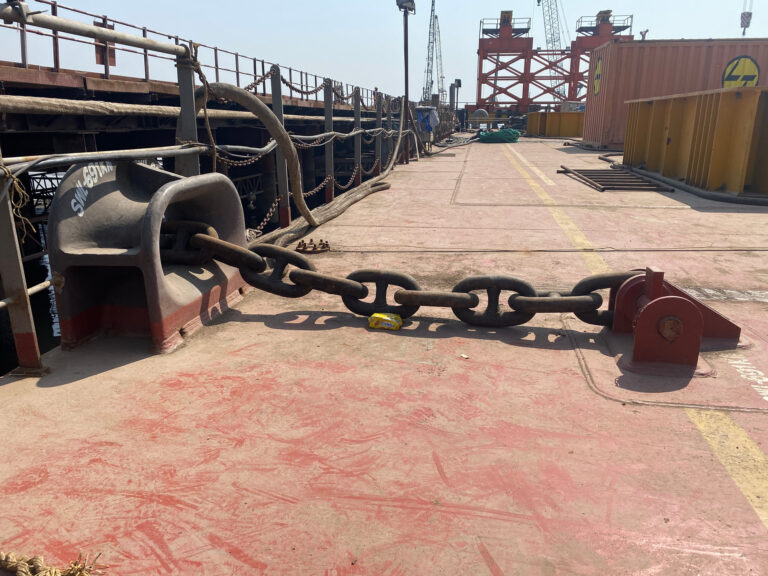
Stud link anchor chain is supplied in shots of 27.5 m. Two grades cover almost everything that gets specified — U2 and U3 — differing in steel, heat…
Read more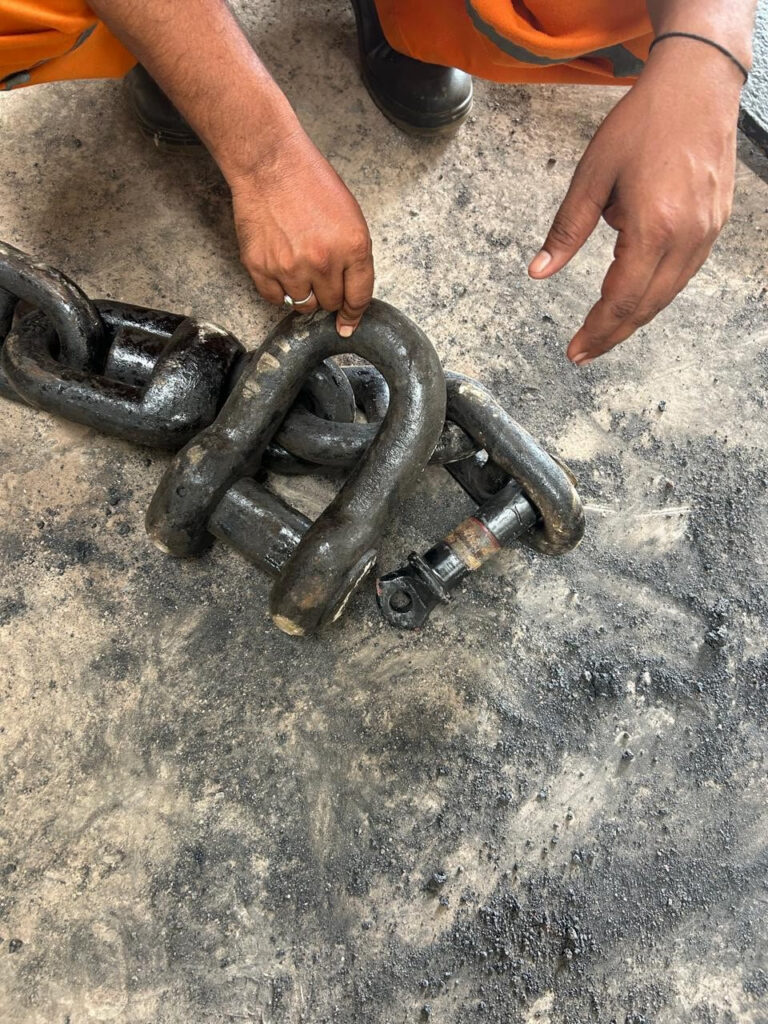 Anchor chain
Offshore mooring chain
Offshore mooring chain is a different product family from ship anchor chain — different grades, different steels, different approvals and a far…
Read more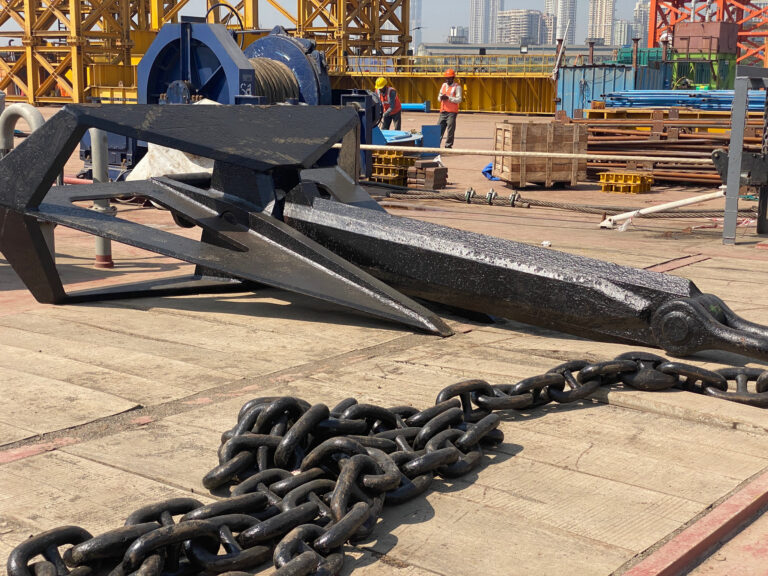 Anchors
AC-14 HHP anchor
The AC-14 is the standard modern high-holding-power bower anchor: wide crown, long broad flukes, around 35° fluke angle. An approved AC-14 design may…
Read more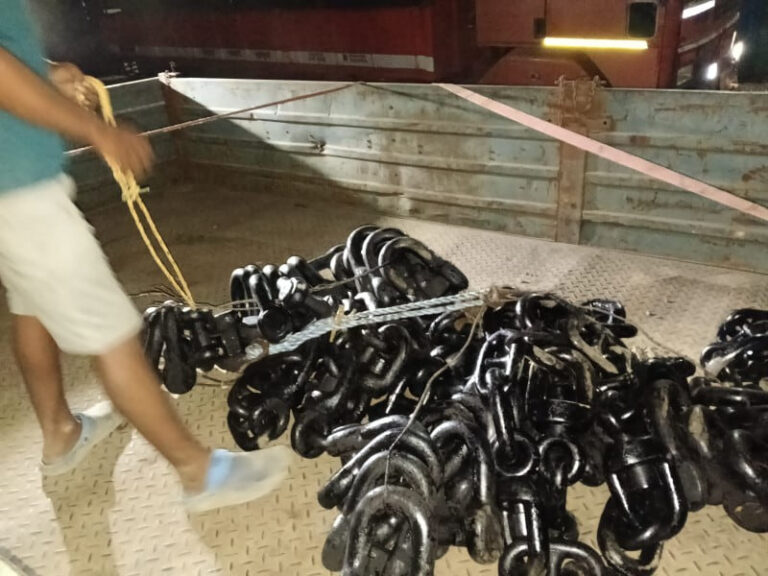 Chain accessories
Kenter joining shackle
A Kenter shackle joins two shots of anchor chain. It is built as two interlocking halves with a central stud, forming a link of the same length and…
Read moreTell us the diameter.
Send the diameter, the grade and the quantity — or the vessel’s Equipment Number if you are starting from scratch — and we will come back with availability and the certification package.