
Chain accessories
Kenter Type Joining Shackle
A Kenter shackle joins two shots of anchor chain. It is built as two interlocking halves with a central stud, forming a link of the same length and pitch as a common link — which is the entire point, because it has to pass over the windlass cable lifter without snagging.
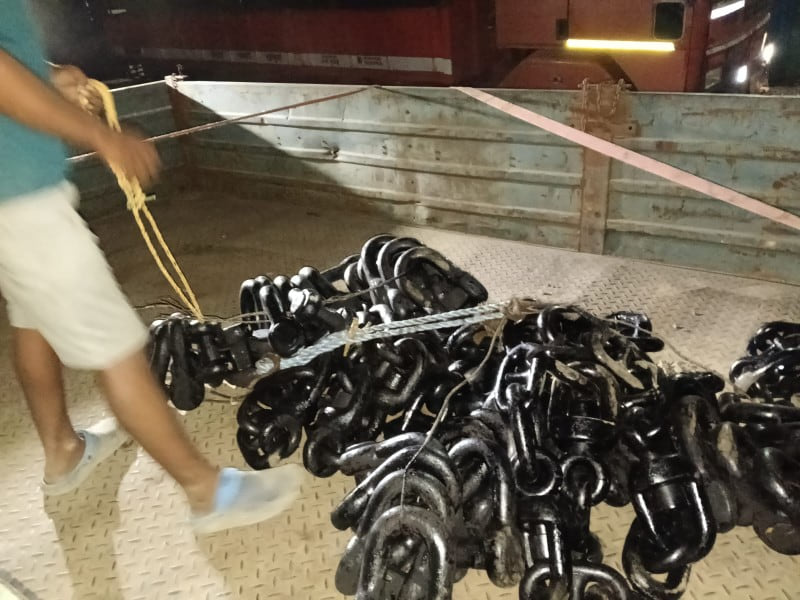
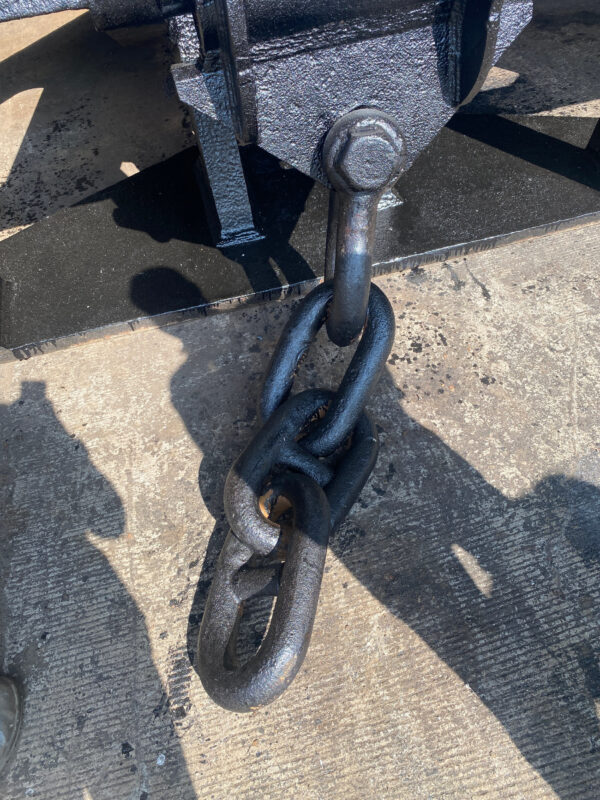
How it works, and why it is shaped the way it is
A Kenter is not a shackle in the rigging sense. It is a link, split diagonally into two identical dovetailed halves that interlock around the two end links being joined. A separate stud drops into the middle, and a tapered pin driven through the assembly locks the whole thing. The pin is then retained by a lead plug hammered into the recess over its head — a soft, sacrificial closure that will not corrode into the steel and can be driven out again when the cable is broken.
Every dimension is dictated by that one requirement: the assembled Kenter must occupy the same length (6d) and the same pitch (4d) as the common links either side of it, so the cable lifter’s pockets receive it exactly as they receive any other link. It is slightly wider — around 4.2d against a common link’s 3.6d — which is why the pocket profile and the chain stopper have to suit.
Loads: the same as the chain, by requirement
The proof and breaking loads in the table below are identical to those for stud link chain of the same diameter. That is not a coincidence and not a convenience — an accessory is required to be proof-tested at the proof load of the chain it serves. A Kenter that tested lower would be the designed weak point of the cable.
Accessories are also made in a minimum of Grade 2 steel, whatever the grade of the chain, and are forged or cast rather than flash-butt welded.
The test certificate that separates real from re-sold
Kenter shackles are break-tested one unit per batch of 50 — a looser sampling than the one-in-25 that applies to other accessories, because they are made in larger runs. Every unit is proof-loaded. When you buy Kenters, ask for the batch break-test certificate and check the batch identity ties to the units delivered. A pile of shackles with a proof certificate and no batch break test is not a certified accessory.
Practical notes
- Match the Kenter to the chain diameter and grade, not to the last one that fitted. The marking on the chain’s end link is the reference.
- Keep the lead plug. Driving a Kenter without renewing the plug leaves the tapered pin free to work out.
- A Kenter is the standard place to mark the cable — shots are counted by the joining shackles, and the paint and wire turns go on and either side of them.
- Check the chain stopper and cable lifter will pass the shackle’s greater width before ordering a size you have not used before.
Specification
Kenter type joining shackle — dimensions and loads
Every size in the series. Scroll sideways on a phone.
| Nominal diameter d mm | Length L1 mm6,0 d | Pitch P4 mm4,0 d | Width W4 mm4,2 d | Stud/pin K mm1,52 d | Proof load U2 kN0,00981 d²(44 − 0,08 d) | Proof load U3 kN0,01373 d²(44 − 0,08 d) | Breaking load U2 kN0,01373 d²(44 − 0,08 d) | Breaking load U3 kN0,01961 d²(44 − 0,08 d) |
|---|---|---|---|---|---|---|---|---|
| 12.5 | 75 | 50 | 52.5 | 19 | 66 | — | 92 | — |
| 14 | 84 | 56 | 58.8 | 21.3 | 82 | — | 115 | — |
| 16 | 96 | 64 | 67.2 | 24.3 | 107 | 150 | 150 | 214 |
| 17.5 | 105 | 70 | 73.5 | 26.6 | 128 | 179 | 179 | 256 |
| 19 | 114 | 76 | 79.8 | 28.9 | 150 | 211 | 211 | 301 |
| 20.5 | 123 | 82 | 86.1 | 31.2 | 175 | 244 | 244 | 349 |
| 22 | 132 | 88 | 92.4 | 33.4 | 201 | 281 | 281 | 401 |
| 24 | 144 | 96 | 100.8 | 36.5 | 238 | 333 | 333 | 475 |
| 26 | 156 | 104 | 109.2 | 39.5 | 278 | 389 | 389 | 556 |
| 28 | 168 | 112 | 117.6 | 42.6 | 321 | 450 | 450 | 642 |
| 30 | 180 | 120 | 126 | 45.6 | 367 | 514 | 514 | 734 |
| 32 | 192 | 128 | 134.4 | 48.6 | 416 | 583 | 583 | 832 |
| 34 | 204 | 136 | 142.8 | 51.7 | 468 | 655 | 655 | 936 |
| 36 | 216 | 144 | 151.2 | 54.7 | 523 | 732 | 732 | 1045 |
| 38 | 228 | 152 | 159.6 | 57.8 | 580 | 812 | 812 | 1160 |
| 40 | 240 | 160 | 168 | 60.8 | 640 | 896 | 896 | 1280 |
| 42 | 252 | 168 | 176.4 | 63.8 | 703 | 984 | 984 | 1406 |
| 44 | 264 | 176 | 184.8 | 66.9 | 769 | 1076 | 1076 | 1537 |
| 46 | 276 | 184 | 193.2 | 69.9 | 837 | 1171 | 1171 | 1673 |
| 48 | 288 | 192 | 201.6 | 73 | 908 | 1270 | 1270 | 1814 |
| 50 | 300 | 200 | 210 | 76 | 981 | 1373 | 1373 | 1961 |
| 52 | 312 | 208 | 218.4 | 79 | 1057 | 1479 | 1479 | 2113 |
| 54 | 324 | 216 | 226.8 | 82.1 | 1135 | 1589 | 1589 | 2269 |
| 56 | 336 | 224 | 235.2 | 85.1 | 1216 | 1702 | 1702 | 2430 |
| 58 | 348 | 232 | 243.6 | 88.2 | 1299 | 1818 | 1818 | 2597 |
| 60 | 360 | 240 | 252 | 91.2 | 1384 | 1938 | 1938 | 2767 |
| 62 | 372 | 248 | 260.4 | 94.2 | 1472 | 2060 | 2060 | 2943 |
| 64 | 384 | 256 | 268.8 | 97.3 | 1562 | 2187 | 2187 | 3123 |
| 66 | 396 | 264 | 277.2 | 100.3 | 1655 | 2316 | 2316 | 3308 |
| 68 | 408 | 272 | 285.6 | 103.4 | 1749 | 2448 | 2448 | 3496 |
| 70 | 420 | 280 | 294 | 106.4 | 1846 | 2583 | 2583 | 3690 |
| 73 | 438 | 292 | 306.6 | 111 | 1995 | 2792 | 2792 | 3988 |
| 76 | 456 | 304 | 319.2 | 115.5 | 2149 | 3007 | 3007 | 4295 |
| 78 | 468 | 312 | 327.6 | 118.6 | 2254 | 3154 | 3154 | 4505 |
| 81 | 486 | 324 | 340.2 | 123.1 | 2415 | 3380 | 3380 | 4827 |
| 84 | 504 | 336 | 352.8 | 127.7 | 2580 | 3612 | 3612 | 5158 |
| 87 | 522 | 348 | 365.4 | 132.2 | 2750 | 3849 | 3849 | 5498 |
| 90 | 540 | 360 | 378 | 136.8 | 2924 | 4093 | 4093 | 5845 |
| 92 | 552 | 368 | 386.4 | 139.8 | 3042 | 4258 | 4258 | 6081 |
| 95 | 570 | 380 | 399 | 144.4 | 3223 | 4510 | 4510 | 6442 |
| 97 | 582 | 388 | 407.4 | 147.4 | 3345 | 4682 | 4682 | 6687 |
| 100 | 600 | 400 | 420 | 152 | 3532 | 4943 | 4943 | 7060 |
| 102 | 612 | 408 | 428.4 | 155 | 3658 | 5120 | 5120 | 7312 |
| 105 | 630 | 420 | 441 | 159.6 | 3850 | 5389 | 5389 | 7697 |
| 107 | 642 | 428 | 449.4 | 162.6 | 3980 | 5571 | 5571 | 7957 |
| 111 | 666 | 444 | 466.2 | 168.7 | 4245 | 5941 | 5941 | 8486 |
| 114 | 684 | 456 | 478.8 | 173.3 | 4447 | 6224 | 6224 | 8889 |
| 117 | 702 | 468 | 491.4 | 177.8 | 4652 | 6511 | 6511 | 9299 |
| 120 | 720 | 480 | 504 | 182.4 | 4859 | 6801 | 6801 | 9714 |
| 122 | 732 | 488 | 512.4 | 185.4 | 4999 | 6997 | 6997 | 9994 |
| 124 | 744 | 496 | 520.8 | 188.5 | 5141 | 7195 | 7195 | 10,276 |
| 127 | 762 | 508 | 533.4 | 193 | 5354 | 7494 | 7494 | 10,703 |
| 130 | 780 | 520 | 546 | 197.6 | 5571 | 7796 | 7796 | 11,135 |
| 132 | 792 | 528 | 554.4 | 200.6 | 5716 | 8000 | 8000 | 11,426 |
| 137 | 822 | 548 | 575.4 | 208.2 | 6083 | 8514 | 8514 | 12,161 |
| 142 | 852 | 568 | 596.4 | 215.8 | 6456 | 9036 | 9036 | 12,906 |
| 147 | 882 | 588 | 617.4 | 223.4 | 6834 | 9565 | 9565 | 13,662 |
| 152 | 912 | 608 | 638.4 | 231 | 7217 | 10,100 | 10,100 | 14,426 |
| 157 | 942 | 628 | 659.4 | 238.6 | 7602 | 10,640 | 10,640 | 15,197 |
| 162 | 972 | 648 | 680.4 | 246.2 | 7991 | 11,185 | 11,185 | 15,975 |
Where these numbers come from. An accessory is proof- and break-tested at the load of the chain it serves, so the load columns here are the same UR W18 values as the chain table — that identity is a requirement, not a coincidence. Dimensions are the ISO 1704 proportions of the chain diameter d. A Kenter shackle takes the same length and pitch as a common link precisely so it passes over the windlass gypsy. Break test: one unit per batch of 50.
Documentation
What comes with the goods
- Proof load on every unit, at the proof load of the chain grade it serves
- Breaking-load test on one unit per batch of 50, with batch identity traceable to the units supplied
- Works certificate — material (Grade 2 steel minimum), forging or casting method, heat treatment
- Dimensional check: diameter +5 % / −0, other dimensions ±2.5 %
Tell us the class your vessel is being built or surveyed to and we will quote against it, with the certificates that class requires. If you are replacing a shot of chain or a single accessory, send us the diameter and the grade stamped on the end link and we will match it.
Frequently asked questions
What is the difference between a Kenter shackle and a D shackle?
Their jobs. A Kenter joins two shots of chain to each other and is shaped as a link so it passes over the cable lifter. A D-type anchor shackle connects the anchor to the first shot of chain and stays outside the hawse pipe, so it can be a conventional bow-and-pin shackle. They are not interchangeable in either direction.
Why is a Kenter shackle held together with lead?
The tapered locking pin is retained by a lead plug driven into the recess over its head. Lead is soft, will not seize or corrode into the steel, and can be driven out again when the cable has to be broken — while still being dense enough to stay put under working conditions. It is a sacrificial closure and should be renewed every time the shackle is made up.
What proof load does a Kenter shackle have?
The same proof load as the chain it joins, at the same diameter and grade — an accessory is required to be proof-tested at the chain’s proof load. The full table is on this page. A joining shackle rated below the chain would make itself the designed failure point of the cable.
How often are Kenter shackles break-tested?
One unit per batch of 50 is destructively break-tested; every unit is proof-loaded. Other chain accessories — end shackles, swivels, enlarged links — are break-tested one per batch of 25. Ask for the batch certificate and check that the batch it names is the batch you were sent.
Related
 Anchor chain
Stud link anchor chain
Stud link anchor chain is supplied in shots of 27.5 m. Two grades cover almost everything that gets specified — U2 and U3 — differing in steel, heat…
Read moreChain accessoriesD type anchor shackle
The D type anchor shackle is the heavy end shackle that connects the anchor shank to the first length of chain cable. It is a straight-sided bow with…
Read more Chain accessories
Swivel forerunner
The swivel forerunner is the made-up assembly between the anchor shackle and the first shot of chain. It lets the cable rotate and shed turns, so the…
Read more Reference
Class certification
In India the commercial gate on anchors and chain is class, and for most Indian-flag tonnage that means IRS. This page sets out what the…
Read moreTell us the diameter.
Send the diameter, the grade and the quantity — or the vessel’s Equipment Number if you are starting from scratch — and we will come back with availability and the certification package.