
Anchors
High Holding Power Stockless Anchors — Balanced and Delta Fluke Patterns
Beyond the AC-14 sit two families of high-holding-power stockless anchor: fully balanced cast patterns, and plate-built delta fluke designs. Both are proprietary geometries, so the type approval and the dimensions belong to the individual design rather than to a generic table.
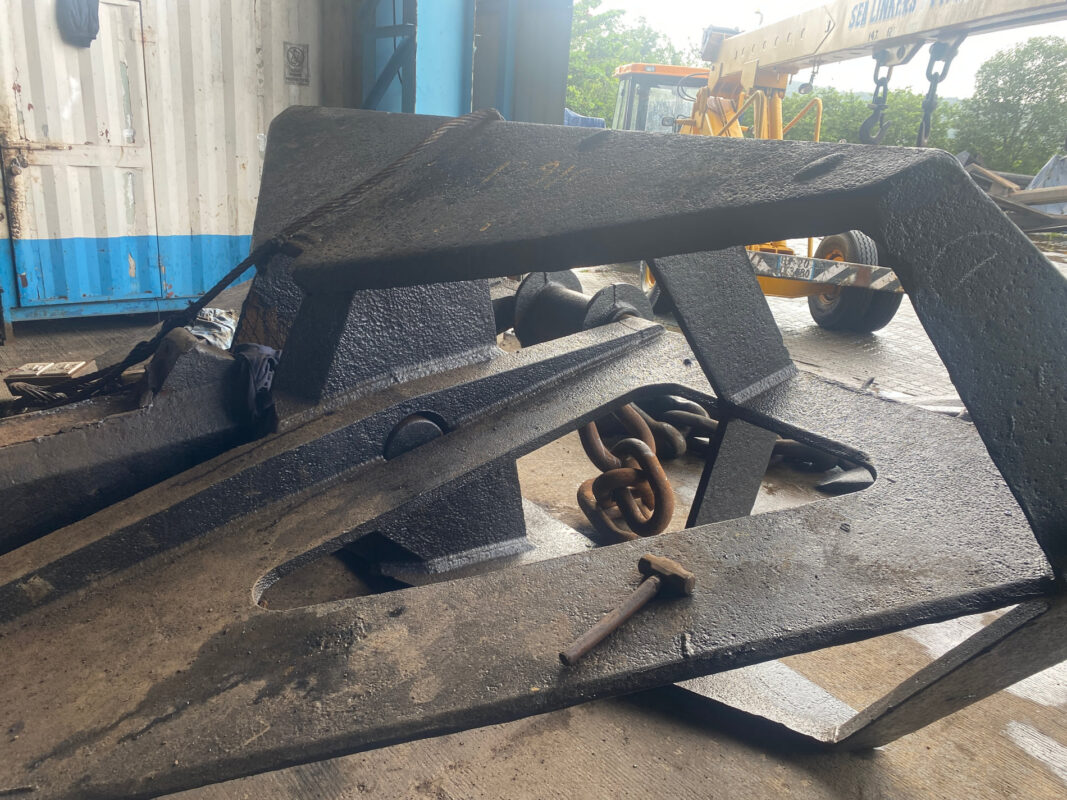
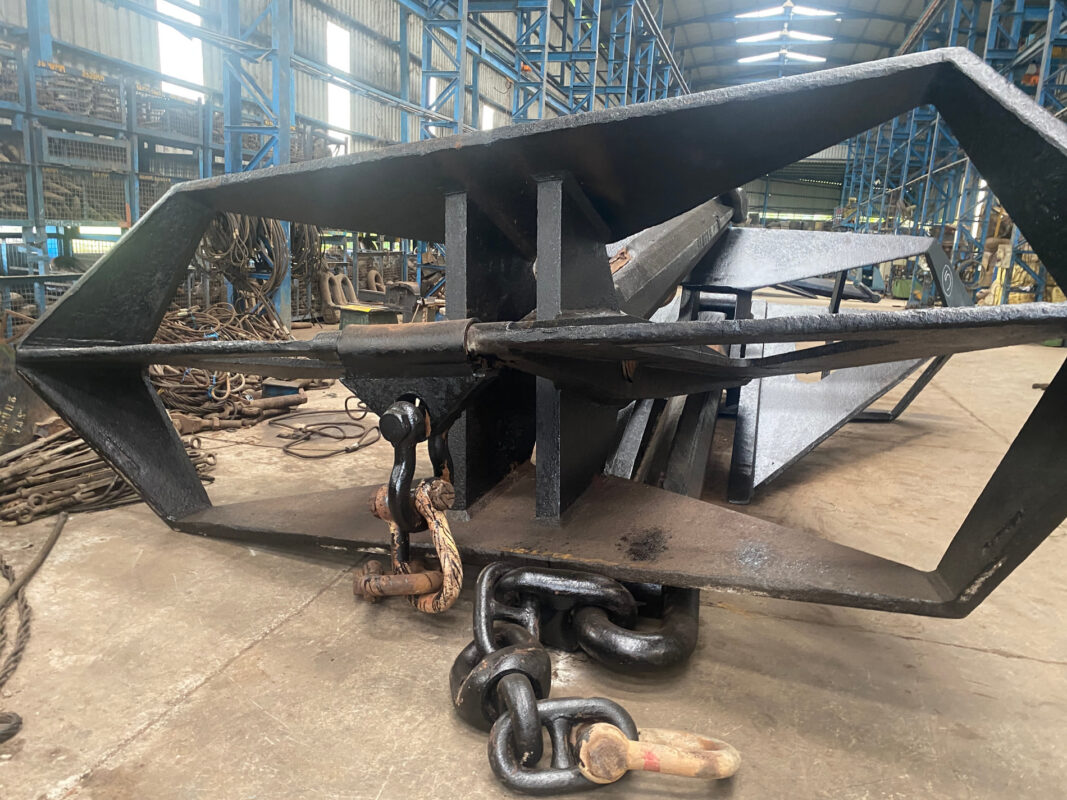
Fully balanced patterns
“Fully balanced” describes a head whose mass is distributed so the anchor self-orients as it lands and draws flush into the hawse without being coaxed. The practical benefits are on deck rather than on the seabed: the anchor comes home the same way every time, it does not hang crooked in the pipe, and it does not need a shell recess cut to accommodate a bad stow.
These are cast anchors with a fluke opening around 40°, made across a very wide mass range — the published series for these patterns runs from small-craft sizes right up to the heaviest merchant outfits.
Plate-built delta fluke patterns
The delta or pyramid fluke anchor is fabricated from plate rather than cast, giving a broad triangular fluke and a fluke angle around 35°. The plate construction allows very large sizes to be built economically, which is why this family dominates the heavy end — offshore units, large tankers and bulk carriers, and anchor-handling work where the anchor itself is the cargo.
Why there is no dimension table here
The chain and accessory tables elsewhere on this site are generated from the published class formulas and the proportional dimensional standard, so they are the same whoever makes the product. Anchor geometry is not like that. The mass series is standard, but the actual dimensions of a balanced or delta-fluke head are the individual designer’s, and they differ between approved designs that carry the same generic description.
Publishing one maker’s dimensions under a generic heading would tell you something that is true of exactly one anchor. Instead: tell us the mass, or the Equipment Number, and the hawse pipe and shackle pin dimensions you have to fit, and we will come back with the specific approved design that suits and its actual dimensions.
What to hold the supplier to
- The type-approval certificate, naming the design, from a classification society.
- Confirmation that the size supplied falls within the approval — an approval reaches only ten times the mass of the heaviest size sea-trialled.
- The proof-load certificate at 1.33 × the actual mass, which is the HHP test regime.
- The hawse pipe and stowage check done before the order, not after delivery.
Specification
Standard anchor mass series — ordinary stockless and the HHP equivalent
Every size in the series. Scroll sideways on a phone.
| Ordinary stockless anchor mass kgIACS UR A1 Table 1 | Approved HHP equivalent kg75 % of Table 1 mass | Min. head mass, ordinary stockless kg≥ 60 % of total |
|---|---|---|
| 180 | 135 | 108 |
| 240 | 180 | 144 |
| 300 | 225 | 180 |
| 360 | 270 | 216 |
| 420 | 315 | 252 |
| 480 | 360 | 288 |
| 570 | 428 | 342 |
| 660 | 495 | 396 |
| 780 | 585 | 468 |
| 900 | 675 | 540 |
| 1020 | 765 | 612 |
| 1140 | 855 | 684 |
| 1290 | 968 | 774 |
| 1440 | 1080 | 864 |
| 1590 | 1193 | 954 |
| 1740 | 1305 | 1044 |
| 1920 | 1440 | 1152 |
| 2100 | 1575 | 1260 |
| 2280 | 1710 | 1368 |
| 2460 | 1845 | 1476 |
| 2640 | 1980 | 1584 |
| 2850 | 2138 | 1710 |
| 3060 | 2295 | 1836 |
| 3300 | 2475 | 1980 |
| 3540 | 2655 | 2124 |
| 3780 | 2835 | 2268 |
| 4050 | 3038 | 2430 |
| 4320 | 3240 | 2592 |
| 4590 | 3443 | 2754 |
| 4890 | 3668 | 2934 |
| 5250 | 3938 | 3150 |
| 5610 | 4208 | 3366 |
| 6000 | 4500 | 3600 |
| 6450 | 4838 | 3870 |
| 6900 | 5175 | 4140 |
| 7350 | 5513 | 4410 |
| 7800 | 5850 | 4680 |
| 8300 | 6225 | 4980 |
| 8700 | 6525 | 5220 |
| 9300 | 6975 | 5580 |
| 9900 | 7425 | 5940 |
| 10,500 | 7875 | 6300 |
| 11,100 | 8325 | 6660 |
| 11,700 | 8775 | 7020 |
| 12,300 | 9225 | 7380 |
| 12,900 | 9675 | 7740 |
| 13,500 | 10,125 | 8100 |
| 14,100 | 10,575 | 8460 |
| 14,700 | 11,025 | 8820 |
| 15,400 | 11,550 | 9240 |
| 16,100 | 12,075 | 9660 |
| 16,900 | 12,675 | 10,140 |
| 17,800 | 13,350 | 10,680 |
| 18,800 | 14,100 | 11,280 |
| 20,000 | 15,000 | 12,000 |
| 21,500 | 16,125 | 12,900 |
| 23,000 | 17,250 | 13,800 |
| 24,500 | 18,375 | 14,700 |
| 26,000 | 19,500 | 15,600 |
| 27,500 | 20,625 | 16,500 |
| 29,000 | 21,750 | 17,400 |
| 31,000 | 23,250 | 18,600 |
| 33,000 | 24,750 | 19,800 |
| 35,500 | 26,625 | 21,300 |
| 38,500 | 28,875 | 23,100 |
| 42,000 | 31,500 | 25,200 |
| 46,000 | 34,500 | 27,600 |
Where these numbers come from. Masses are the standard series of IACS UR A1 Table 1, selected from a vessel’s Equipment Number. An anchor of approved high-holding-power design may be 75 % of the tabulated mass, because it must demonstrate at least twice the holding power of an ordinary stockless anchor of equal mass in full-scale sea trials. Proof loads are set by UR A1 Table 2 and appear on the anchor’s certificate — an HHP anchor is proof-tested at the load for 1,33 × its actual mass. Individual anchor mass may vary ±7 % provided the total for the outfit is met.
Documentation
What comes with the goods
- Type-approval certificate naming the approved design
- Confirmation the supplied size falls within the approval
- Proof-load certificate at 1.33 × the actual anchor mass
- Works certificate — material, manufacture and heat treatment
Tell us the class your vessel is being built or surveyed to and we will quote against it, with the certificates that class requires. If you are replacing a shot of chain or a single accessory, send us the diameter and the grade stamped on the end link and we will match it.
Frequently asked questions
What does "fully balanced" mean on an anchor?
That the head’s mass distribution makes the anchor self-orient as it lands and draw flush into the hawse pipe without being worked. It is a stowage and handling characteristic, not a class grade and not a holding-power claim — an anchor can be fully balanced and not be approved as high holding power, and vice versa.
Why can I not see the dimensions on this page?
Because they belong to individual approved designs rather than to a standard. The chain and accessory tables on this site are generated from published class formulas and are therefore true of any compliant product; anchor head geometry is not standardised in that way. Send us the mass or the Equipment Number and the hawse pipe dimensions and we will give you the actual figures for the design that suits.
Cast or plate-built — does it matter?
For most vessels, no: both routes are covered by the manufacturing requirements a society applies to anchors, and both are proof-tested the same way. Plate construction tends to dominate the very large sizes because it builds economically at scale. What matters more is whether the specific design holds a current type approval that covers the size you need.
Related
 Anchors
AC-14 HHP anchor
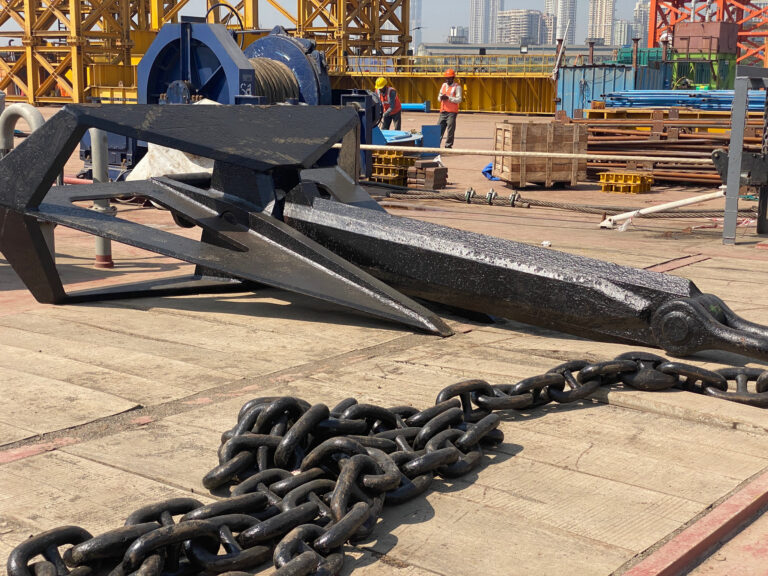
The AC-14 is the standard modern high-holding-power bower anchor: wide crown, long broad flukes, around 35° fluke angle. An approved AC-14 design may…
Read more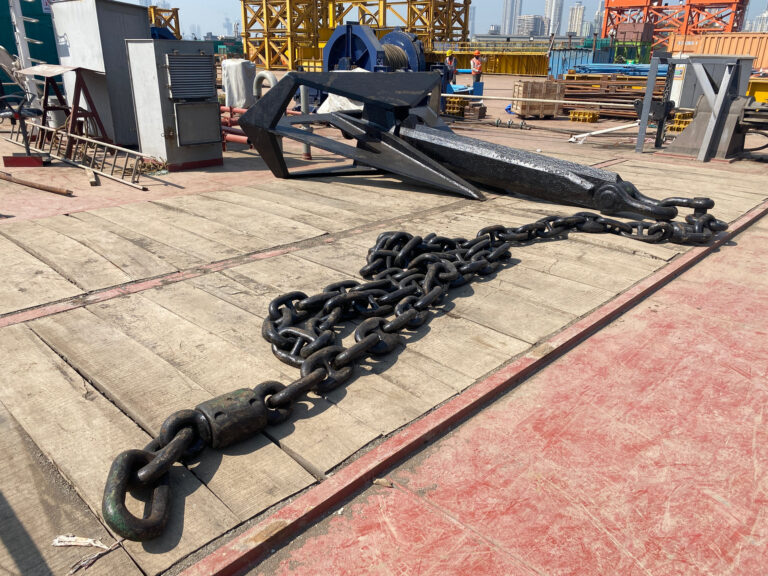 Anchors
Hall anchor
The Hall is the plain stockless bower anchor: two arms hinged at the crown, no stock, and a shank that draws straight into the hawse pipe. It carries…
Read moreAnchorsSpek anchor
The Spek is a stockless bower anchor with a broad flat crown and slender pointed flukes — a development of the Hall aimed at better tripping and…
Read more Reference
Class certification
In India the commercial gate on anchors and chain is class, and for most Indian-flag tonnage that means IRS. This page sets out what the…
Read moreGuides
Tell us the diameter.
Send the diameter, the grade and the quantity — or the vessel’s Equipment Number if you are starting from scratch — and we will come back with availability and the certification package.