
Anchors
Spek Anchor — Stockless Bower Anchor
The Spek is a stockless bower anchor with a broad flat crown and slender pointed flukes — a development of the Hall aimed at better tripping and flatter stowage. Whether a given Spek is approved as high holding power is a question for its certificate, not its name.
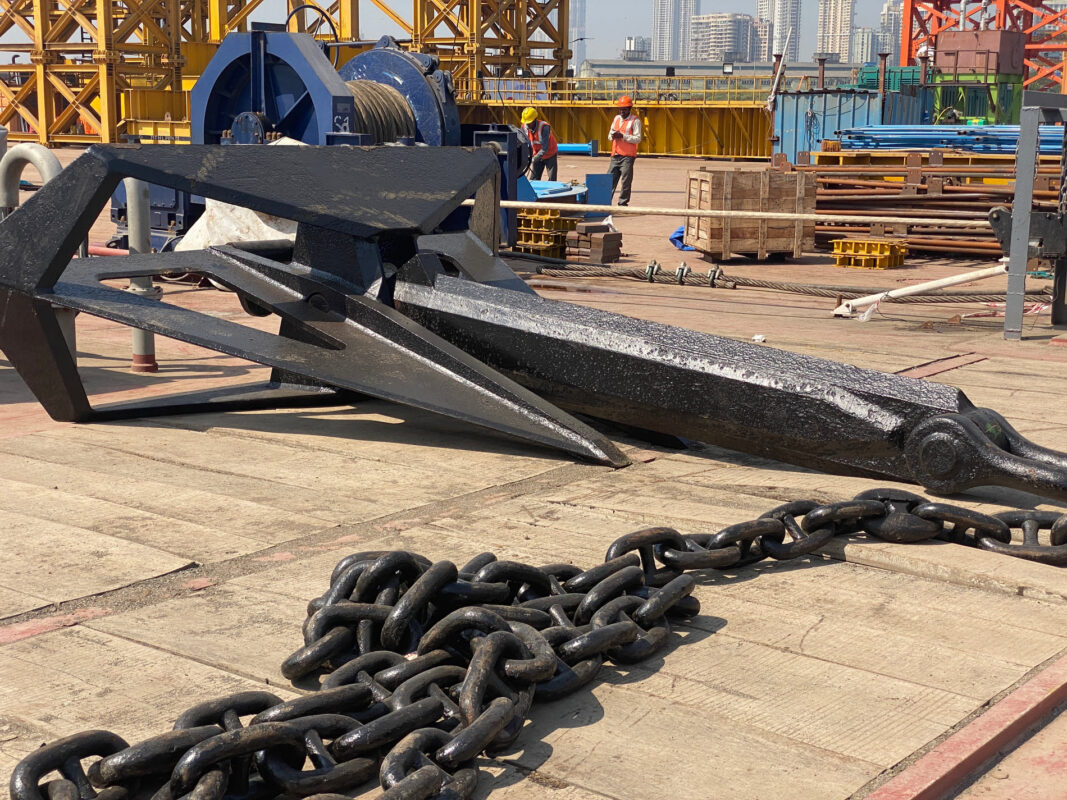
What distinguishes a Spek
Set a Spek beside a Hall and the difference is in the crown. Where the Hall carries a deep boxed crown, the Spek has a broad flat base plate that gives a wide bearing area, with more slender, more sharply pointed flukes rising from it. The fluke angle is tighter — around 40° against the Hall’s 42°. The intent is a head that trips more readily on a hard bottom and stows flatter against the shell.
The point that gets specified wrong
Spek anchors are frequently offered as high holding power, and many are. But high holding power is a property of an individual approved design, not of a pattern name. A society approves a specific anchor design after full-scale sea trials showing at least twice the holding power of an ordinary stockless anchor of the same mass, on several bottom types, with at least two sizes tested. The approval names the design.
So “Spek anchor, HHP” on a purchase order is not a specification — it is two facts that may or may not travel together. Ask for the type-approval certificate and check that the anchor offered is the design it names. If it is not, the anchor is an ordinary stockless anchor and must be supplied at the full tabulated mass.
Where a Spek is the right answer
On offshore support vessels, tugs and general cargo tonnage where the anchor has to bed reliably in mixed ground and stow flush, the Spek pattern is a common specification. It is also frequently what a vessel already carries, in which case the practical question is simply matching the replacement to the existing hawse pipe and cable — send us the mass and the shackle pin diameter and we will work from that.
Specification
Standard anchor mass series — ordinary stockless and the HHP equivalent
Every size in the series. Scroll sideways on a phone.
| Ordinary stockless anchor mass kgIACS UR A1 Table 1 | Approved HHP equivalent kg75 % of Table 1 mass | Min. head mass, ordinary stockless kg≥ 60 % of total |
|---|---|---|
| 180 | 135 | 108 |
| 240 | 180 | 144 |
| 300 | 225 | 180 |
| 360 | 270 | 216 |
| 420 | 315 | 252 |
| 480 | 360 | 288 |
| 570 | 428 | 342 |
| 660 | 495 | 396 |
| 780 | 585 | 468 |
| 900 | 675 | 540 |
| 1020 | 765 | 612 |
| 1140 | 855 | 684 |
| 1290 | 968 | 774 |
| 1440 | 1080 | 864 |
| 1590 | 1193 | 954 |
| 1740 | 1305 | 1044 |
| 1920 | 1440 | 1152 |
| 2100 | 1575 | 1260 |
| 2280 | 1710 | 1368 |
| 2460 | 1845 | 1476 |
| 2640 | 1980 | 1584 |
| 2850 | 2138 | 1710 |
| 3060 | 2295 | 1836 |
| 3300 | 2475 | 1980 |
| 3540 | 2655 | 2124 |
| 3780 | 2835 | 2268 |
| 4050 | 3038 | 2430 |
| 4320 | 3240 | 2592 |
| 4590 | 3443 | 2754 |
| 4890 | 3668 | 2934 |
| 5250 | 3938 | 3150 |
| 5610 | 4208 | 3366 |
| 6000 | 4500 | 3600 |
| 6450 | 4838 | 3870 |
| 6900 | 5175 | 4140 |
| 7350 | 5513 | 4410 |
| 7800 | 5850 | 4680 |
| 8300 | 6225 | 4980 |
| 8700 | 6525 | 5220 |
| 9300 | 6975 | 5580 |
| 9900 | 7425 | 5940 |
| 10,500 | 7875 | 6300 |
| 11,100 | 8325 | 6660 |
| 11,700 | 8775 | 7020 |
| 12,300 | 9225 | 7380 |
| 12,900 | 9675 | 7740 |
| 13,500 | 10,125 | 8100 |
| 14,100 | 10,575 | 8460 |
| 14,700 | 11,025 | 8820 |
| 15,400 | 11,550 | 9240 |
| 16,100 | 12,075 | 9660 |
| 16,900 | 12,675 | 10,140 |
| 17,800 | 13,350 | 10,680 |
| 18,800 | 14,100 | 11,280 |
| 20,000 | 15,000 | 12,000 |
| 21,500 | 16,125 | 12,900 |
| 23,000 | 17,250 | 13,800 |
| 24,500 | 18,375 | 14,700 |
| 26,000 | 19,500 | 15,600 |
| 27,500 | 20,625 | 16,500 |
| 29,000 | 21,750 | 17,400 |
| 31,000 | 23,250 | 18,600 |
| 33,000 | 24,750 | 19,800 |
| 35,500 | 26,625 | 21,300 |
| 38,500 | 28,875 | 23,100 |
| 42,000 | 31,500 | 25,200 |
| 46,000 | 34,500 | 27,600 |
Where these numbers come from. Masses are the standard series of IACS UR A1 Table 1, selected from a vessel’s Equipment Number. An anchor of approved high-holding-power design may be 75 % of the tabulated mass, because it must demonstrate at least twice the holding power of an ordinary stockless anchor of equal mass in full-scale sea trials. Proof loads are set by UR A1 Table 2 and appear on the anchor’s certificate — an HHP anchor is proof-tested at the load for 1,33 × its actual mass. Individual anchor mass may vary ±7 % provided the total for the outfit is met.
Documentation
What comes with the goods
- Works certificate recording material, casting or forging method and heat treatment
- Proof-load test certificate — an approved HHP anchor is tested at the load for 1.33 × its actual mass
- The individual type-approval certificate, where high holding power is claimed
- Post-proof crack examination and free head-rotation check
Tell us the class your vessel is being built or surveyed to and we will quote against it, with the certificates that class requires. If you are replacing a shot of chain or a single accessory, send us the diameter and the grade stamped on the end link and we will match it.
Frequently asked questions
Is a Spek anchor automatically high holding power?
No. High holding power is an approval granted to a specific anchor design after full-scale sea trials, not a property of the pattern name. Some Spek designs hold it and some do not. Ask for the type-approval certificate and check the design it names matches the anchor being offered — if it does not, the anchor must be supplied at the full ordinary-stockless mass.
What is the difference between a Spek and a Hall anchor?
Mainly the crown and the flukes. A Spek has a broad flat crown plate giving a wide bearing area and more slender pointed flukes, with a fluke angle around 40°; a Hall has a deeper boxed crown and around 42°. The intent of the Spek geometry is easier tripping and flatter stowage. Both are stockless bower anchors that self-stow in the hawse pipe.
How much lighter is an HHP anchor?
An approved high-holding-power anchor may be supplied at 75 % of the mass the class table gives for an ordinary stockless anchor — a 25 % reduction. The trade is that it is proof-tested harder: at the load corresponding to 1.33 times its actual mass.
Do you supply the shackle and swivel with the anchor?
Yes — the anchor shackle, the swivel forerunner and the first shot of chain are normally quoted together, because they all size off the same chain diameter. See the D-type anchor shackle and swivel forerunner pages for the dimensions and loads.
Related
 Anchors
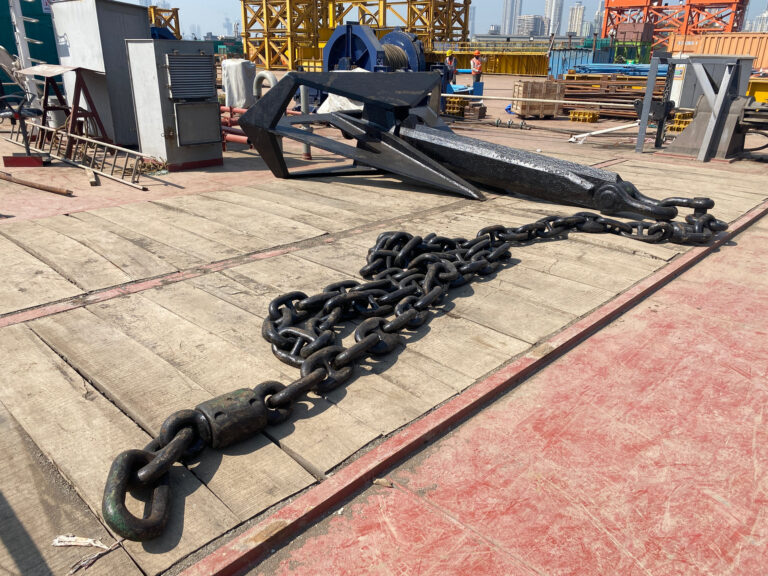
Hall anchor
The Hall is the plain stockless bower anchor: two arms hinged at the crown, no stock, and a shank that draws straight into the hawse pipe. It carries…
Read more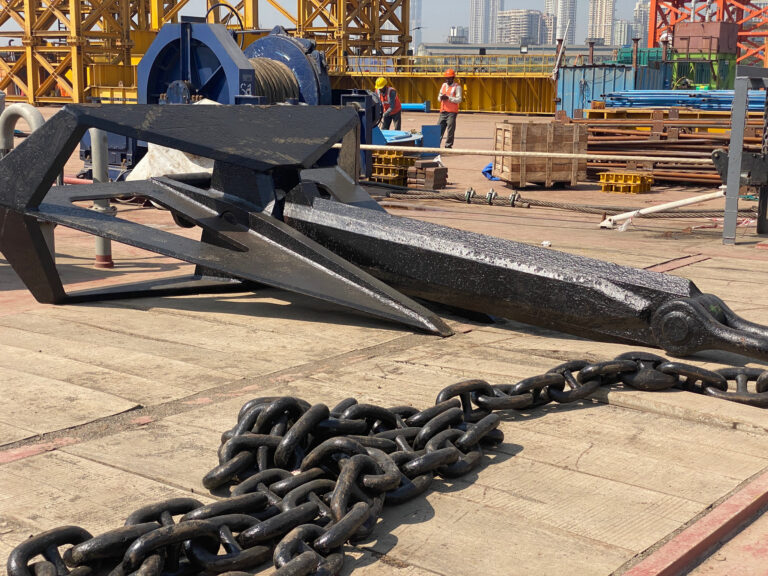 Anchors
AC-14 HHP anchor
The AC-14 is the standard modern high-holding-power bower anchor: wide crown, long broad flukes, around 35° fluke angle. An approved AC-14 design may…
Read more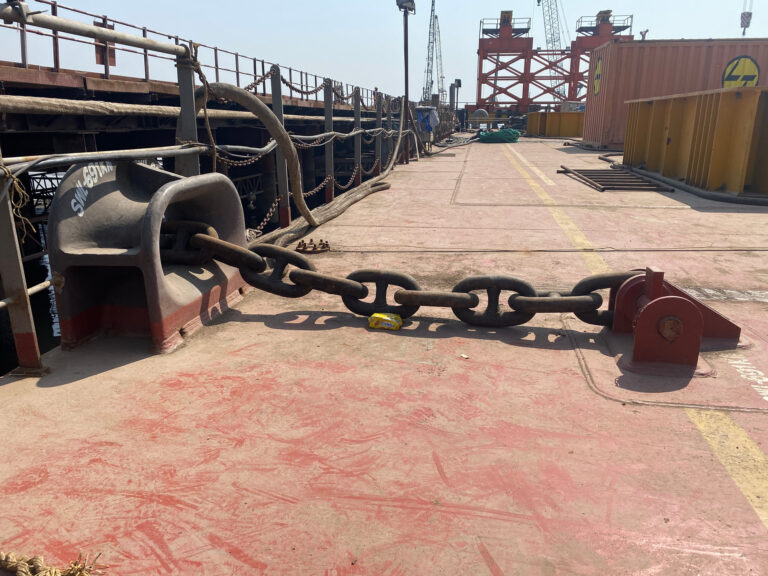 Chain accessories
D type anchor shackle
The D type anchor shackle is the heavy end shackle that connects the anchor shank to the first length of chain cable. It is a straight-sided bow with…
Read more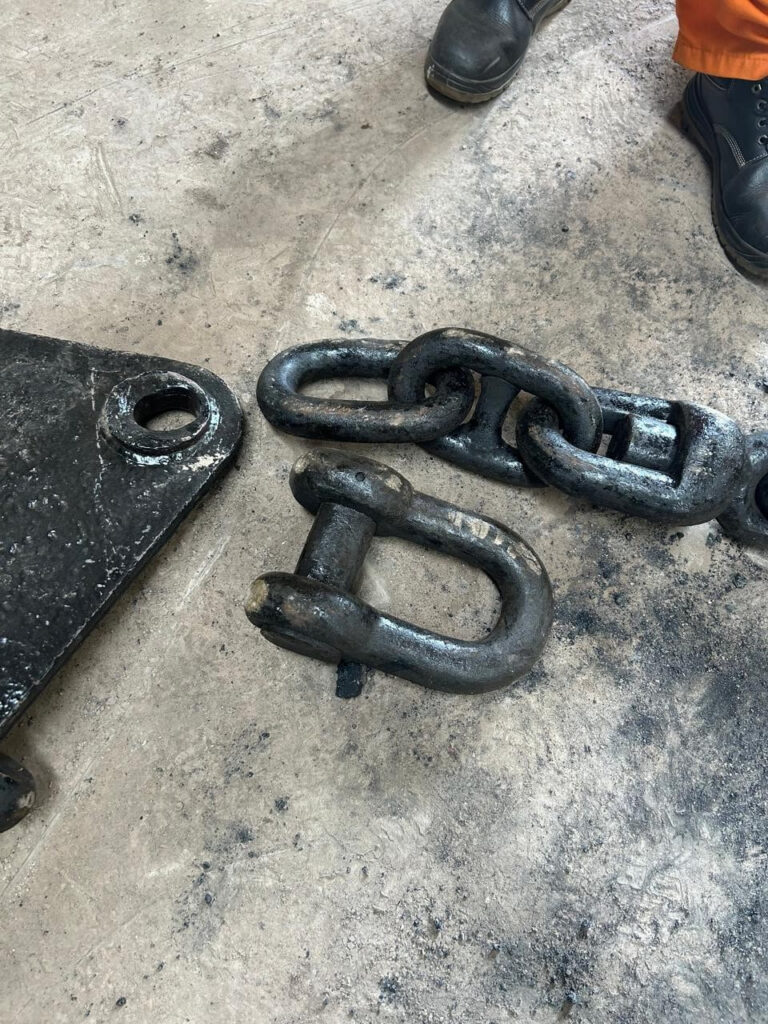 Chain accessories
Swivel forerunner
The swivel forerunner is the made-up assembly between the anchor shackle and the first shot of chain. It lets the cable rotate and shed turns, so the…
Read moreGuides
Tell us the diameter.
Send the diameter, the grade and the quantity — or the vessel’s Equipment Number if you are starting from scratch — and we will come back with availability and the certification package.