
Anchors
Hall Anchor — Stockless Bower Anchor
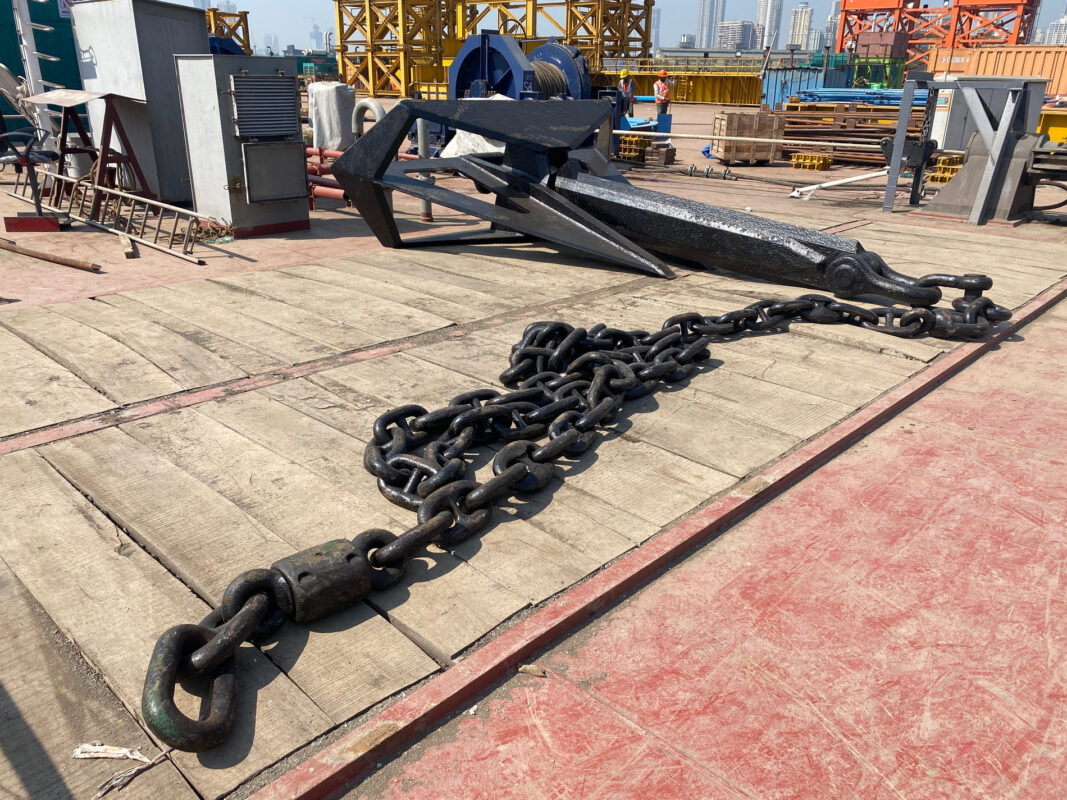
The Hall is the plain stockless bower anchor: two arms hinged at the crown, no stock, and a shank that draws straight into the hawse pipe. It carries no holding-power benefit, so it is specified at the full tabulated mass for the vessel’s Equipment Number.
What a Hall anchor is
A Hall is the first-generation stockless bower anchor and still the reference against which every other pattern is measured. The two arms are cast as one head, hinged on a pin through the shank, and free to pivot roughly 42° either side. There is no stock, so the anchor self-stows: heave it up and the shank follows the hawse pipe while the head beds against the shell plating.
Its virtue is that nothing about it is clever. There are no stabilising bars to bend, no tripping palms to shear, and a casting that a yard anywhere can inspect. Its cost is mass — a Hall holds no better than the ordinary-stockless baseline, so you carry every kilogram the class table asks for.
Choosing between a Hall and a high-holding-power anchor
The decision is almost never about holding power in isolation. It is about what the extra mass costs you elsewhere:
- Windlass and cable lifter. A heavier anchor needs more hoisting effort and often a larger machine. On a newbuild that is a real capital line.
- Hawse pipe and stowage. A larger anchor needs a larger pipe and a bigger recess in the shell.
- Approvals. A high-holding-power design carries an individual type approval that has to be produced and matched to the anchor supplied. A Hall does not.
- Replacement. A Hall is easy to source anywhere. A specific HHP design may not be.
Where mass is cheap and paperwork is a nuisance — barges, work boats, harbour craft, inland tonnage — the Hall keeps winning on those grounds alone. See the AC-14 HHP anchor for the case the other way.
Sizing
Anchor mass is not chosen, it is read off. The vessel’s Equipment Number sets the number of anchors, the mass of each, the chain diameter, the chain grade and the total length of cable — all from one table. Nothing about the anchor pattern changes the Equipment Number; the pattern only changes whether you may take the 25 % mass reduction an approved high-holding-power design allows.
The series below is the standard one. Individual anchor mass may vary ±7 % provided the outfit total is met, and for an ordinary stockless anchor the head — arms, crown, pins and fittings — must be at least 60 % of the total.
Specification
Standard anchor mass series — ordinary stockless and the HHP equivalent
Every size in the series. Scroll sideways on a phone.
| Ordinary stockless anchor mass kgIACS UR A1 Table 1 | Approved HHP equivalent kg75 % of Table 1 mass | Min. head mass, ordinary stockless kg≥ 60 % of total |
|---|---|---|
| 180 | 135 | 108 |
| 240 | 180 | 144 |
| 300 | 225 | 180 |
| 360 | 270 | 216 |
| 420 | 315 | 252 |
| 480 | 360 | 288 |
| 570 | 428 | 342 |
| 660 | 495 | 396 |
| 780 | 585 | 468 |
| 900 | 675 | 540 |
| 1020 | 765 | 612 |
| 1140 | 855 | 684 |
| 1290 | 968 | 774 |
| 1440 | 1080 | 864 |
| 1590 | 1193 | 954 |
| 1740 | 1305 | 1044 |
| 1920 | 1440 | 1152 |
| 2100 | 1575 | 1260 |
| 2280 | 1710 | 1368 |
| 2460 | 1845 | 1476 |
| 2640 | 1980 | 1584 |
| 2850 | 2138 | 1710 |
| 3060 | 2295 | 1836 |
| 3300 | 2475 | 1980 |
| 3540 | 2655 | 2124 |
| 3780 | 2835 | 2268 |
| 4050 | 3038 | 2430 |
| 4320 | 3240 | 2592 |
| 4590 | 3443 | 2754 |
| 4890 | 3668 | 2934 |
| 5250 | 3938 | 3150 |
| 5610 | 4208 | 3366 |
| 6000 | 4500 | 3600 |
| 6450 | 4838 | 3870 |
| 6900 | 5175 | 4140 |
| 7350 | 5513 | 4410 |
| 7800 | 5850 | 4680 |
| 8300 | 6225 | 4980 |
| 8700 | 6525 | 5220 |
| 9300 | 6975 | 5580 |
| 9900 | 7425 | 5940 |
| 10,500 | 7875 | 6300 |
| 11,100 | 8325 | 6660 |
| 11,700 | 8775 | 7020 |
| 12,300 | 9225 | 7380 |
| 12,900 | 9675 | 7740 |
| 13,500 | 10,125 | 8100 |
| 14,100 | 10,575 | 8460 |
| 14,700 | 11,025 | 8820 |
| 15,400 | 11,550 | 9240 |
| 16,100 | 12,075 | 9660 |
| 16,900 | 12,675 | 10,140 |
| 17,800 | 13,350 | 10,680 |
| 18,800 | 14,100 | 11,280 |
| 20,000 | 15,000 | 12,000 |
| 21,500 | 16,125 | 12,900 |
| 23,000 | 17,250 | 13,800 |
| 24,500 | 18,375 | 14,700 |
| 26,000 | 19,500 | 15,600 |
| 27,500 | 20,625 | 16,500 |
| 29,000 | 21,750 | 17,400 |
| 31,000 | 23,250 | 18,600 |
| 33,000 | 24,750 | 19,800 |
| 35,500 | 26,625 | 21,300 |
| 38,500 | 28,875 | 23,100 |
| 42,000 | 31,500 | 25,200 |
| 46,000 | 34,500 | 27,600 |
Where these numbers come from. Masses are the standard series of IACS UR A1 Table 1, selected from a vessel’s Equipment Number. An anchor of approved high-holding-power design may be 75 % of the tabulated mass, because it must demonstrate at least twice the holding power of an ordinary stockless anchor of equal mass in full-scale sea trials. Proof loads are set by UR A1 Table 2 and appear on the anchor’s certificate — an HHP anchor is proof-tested at the load for 1,33 × its actual mass. Individual anchor mass may vary ±7 % provided the total for the outfit is met.
Documentation
What comes with the goods
- Works certificate recording material, casting or forging method and heat treatment
- Proof-load test certificate at the load set by the class table for the anchor’s mass
- Post-proof examination for cracks and a free head-rotation check
- Permanent set after proof load within 1 % on the gauge length
Tell us the class your vessel is being built or surveyed to and we will quote against it, with the certificates that class requires. If you are replacing a shot of chain or a single accessory, send us the diameter and the grade stamped on the end link and we will match it.
Frequently asked questions
How is the anchor mass for my vessel decided?
From the Equipment Number, which is calculated from the vessel’s displacement, the profile area above the waterline and the effective height of the deckhouses. That single number indexes a class table giving the number of anchors, the mass of each, the chain diameter, the chain grade and the total cable length. The anchor pattern does not change the Equipment Number — it only decides whether the 25 % high-holding-power reduction is available.
Is a Hall anchor high holding power?
No. A Hall is an ordinary stockless anchor and is supplied at the full tabulated mass. High holding power is a specific approval: the design has to demonstrate at least twice the holding power of an ordinary stockless anchor of the same mass, in full-scale sea trials on several bottom types, before a society will approve it and allow the mass reduction.
Can I fit a Hall anchor in place of an HHP anchor?
Only at the full tabulated mass, which is 33 % more than the HHP anchor it replaces — and only if the hawse pipe, the stowage recess and the windlass can take it. Substituting like-for-like on mass would leave the vessel under-anchored against its own class table. Check with the class surveyor before ordering.
What is the fluke angle and does it matter?
It is the angle the arms swing through relative to the shank, dimensioned on the anchor drawing — around 42° for a Hall. It matters because it sets how readily the flukes trip and bite when the cable comes taut, and how the anchor sits when it is hove home into the hawse. It is a design characteristic, not something adjusted in service.
Related
 Anchors
Spek anchor
The Spek is a stockless bower anchor with a broad flat crown and slender pointed flukes — a development of the Hall aimed at better tripping and…
Read moreAnchorsAC-14 HHP anchor
The AC-14 is the standard modern high-holding-power bower anchor: wide crown, long broad flukes, around 35° fluke angle. An approved AC-14 design may…
Read more Anchors
Other HHP patterns
Beyond the AC-14 sit two families of high-holding-power stockless anchor: fully balanced cast patterns, and plate-built delta fluke designs. Both are…
Read more Anchor chain
Stud link anchor chain
Stud link anchor chain is supplied in shots of 27.5 m. Two grades cover almost everything that gets specified — U2 and U3 — differing in steel, heat…
Read moreTell us the diameter.
Send the diameter, the grade and the quantity — or the vessel’s Equipment Number if you are starting from scratch — and we will come back with availability and the certification package.