
Anchor chain
Stud Link Anchor Chain Cable — Grades U2 and U3
Stud link anchor chain is supplied in shots of 27.5 m. Two grades cover almost everything that gets specified — U2 and U3 — differing in steel, heat treatment and therefore in strength at the same diameter. The table below gives the link dimensions and every proof and breaking load, generated from the class formulas.
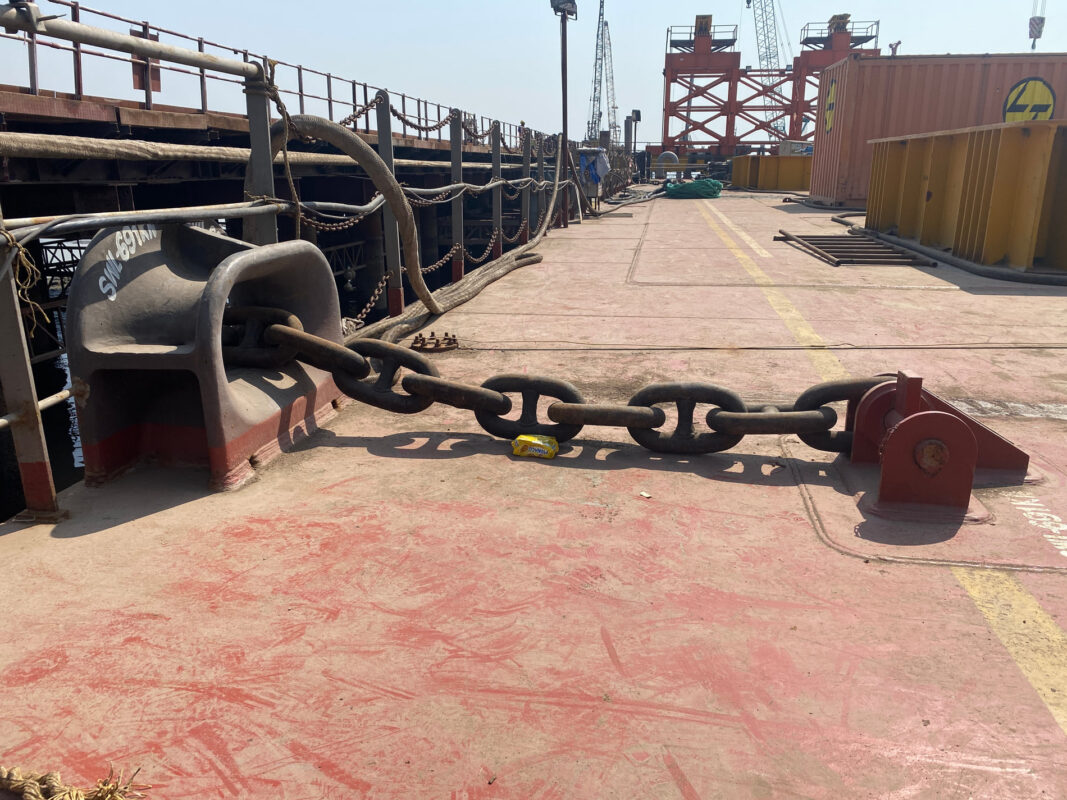
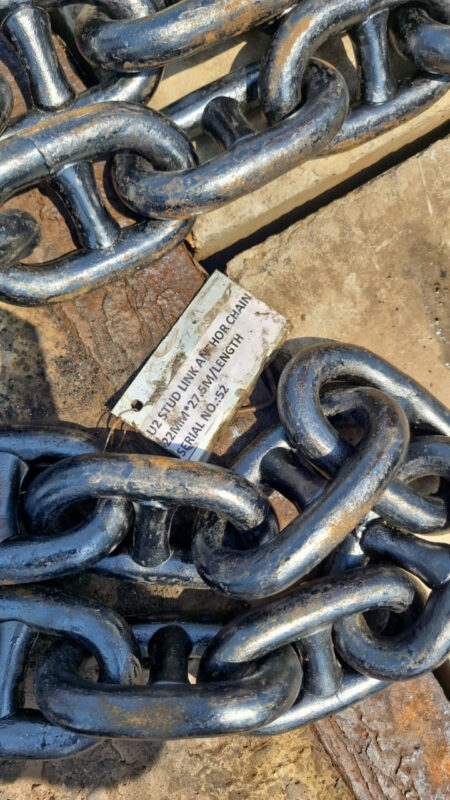
The two grades that get specified, and what separates them
Grade is not a marketing tier. It is a different steel, a different heat treatment and a different test regime, and it changes the diameter you need for a given Equipment Number:
- U2 — special quality, 490–690 N/mm², yield at least 295 N/mm², impact energy 27 J at 0 °C. The workhorse grade: tugs, coasters, general cargo, dredgers and most coastal tonnage.
- U3 — extra special quality, at least 690 N/mm², yield at least 410 N/mm², impact energy 60 J at 0 °C or 35 J at −20 °C, and always heat-treated — normalised, normalised and tempered, or quenched and tempered. Its breaking load is about 1.43 times U2’s at the same diameter, so U3 gives the smallest and lightest cable for a given duty. That matters when the windlass, the hawse pipe and the chain locker are all fixed.
There is a third grade, U1, in mild steel at 300–490 N/mm². It needs the greatest diameter for a given duty and is consequently the heaviest cable, it is generally confined to inland craft and small harbour tonnage, and many owners running high-holding-power anchors will not accept it. We have left it out of the tables so U2 and U3 have the room — ask us if a low Equipment Number genuinely calls for it.
One relationship worth knowing when you read the table: an accessory is proof-tested at the proof load of the chain it serves, and each grade’s proof load is the next grade down’s breaking load. So the columns step through each other one grade apart, at every diameter.
Dimensions are proportions, not a catalogue
Every dimension of a stud link is a fixed multiple of the nominal diameter d: the link is 6d long, the pitch is 4d, the external width is 3.6d and the stud is 1.3d wide. That is what makes chain from different works interchangeable over the same cable lifter, and it is why the table below can be generated rather than copied. A length must comprise an odd number of links.
Shots, shackles and how much cable a vessel carries
Chain is made up and certified in shots — also called shackle lengths — of 27.5 m, joined by Kenter shackles. A vessel typically carries ten to twelve shots per side, so roughly 275 to 330 m of cable on each anchor. The total is set by the same Equipment Number table that sets the anchor mass and the chain diameter, so it is not a free choice.
Testing — and the certificate that is usually missing
Two different tests happen, and buyers routinely receive only one of them:
- Proof load: every single 27.5 m length, in the surveyor’s presence, with the chain free of paint and scale.
- Breaking load: a sample of at least three links from every fourth length, held at load for at least 30 seconds. The sample must have been made, welded and heat-treated with the chain it represents, and cut off in front of the surveyor.
The breaking-load certificate is batch-based, which is precisely why it is the one absent from grey-market and re-certified chain — the seller cannot show the batch the sample came from. If you are buying chain on certificate, ask for that one specifically, and check the stamped marking on the end links matches: grade, certificate number and the society’s stamp appear at both ends of every length.
Wear and replacement
Chain is ranged and gauged at drydock. A link is condemned once its mean diameter has lost 12 % — measured at the crown, where the wear concentrates. Cable is usually turned end for end long before that, so the bitter-end shots that have done little work move to the hawse. If you are replacing shots rather than the whole cable, the replacement must match the grade already on board: send us the marking stamped on the end link.
Specification
Stud link anchor chain cable — dimensions and loads, Grades U2 / U3
Every size in the series. Scroll sideways on a phone.
| Nominal diameter d mm | Link length L mm6,0 d | Link pitch P mm4,0 d | Link width W mm3,6 d | Proof load U2 kN0,00981 d²(44 − 0,08 d) | Proof load U3 kN0,01373 d²(44 − 0,08 d) | Breaking load U2 kN0,01373 d²(44 − 0,08 d) | Breaking load U3 kN0,01961 d²(44 − 0,08 d) | Approx. mass per 27,5 m shot kg≈ 0,0226 d² kg/m — estimate |
|---|---|---|---|---|---|---|---|---|
| 12.5 | 75 | 50 | 45 | 66 | — | 92 | — | 100 |
| 14 | 84 | 56 | 50.4 | 82 | — | 115 | — | 120 |
| 16 | 96 | 64 | 57.6 | 107 | 150 | 150 | 214 | 160 |
| 17.5 | 105 | 70 | 63 | 128 | 179 | 179 | 256 | 190 |
| 19 | 114 | 76 | 68.4 | 150 | 211 | 211 | 301 | 220 |
| 20.5 | 123 | 82 | 73.8 | 175 | 244 | 244 | 349 | 260 |
| 22 | 132 | 88 | 79.2 | 201 | 281 | 281 | 401 | 300 |
| 24 | 144 | 96 | 86.4 | 238 | 333 | 333 | 475 | 360 |
| 26 | 156 | 104 | 93.6 | 278 | 389 | 389 | 556 | 420 |
| 28 | 168 | 112 | 100.8 | 321 | 450 | 450 | 642 | 490 |
| 30 | 180 | 120 | 108 | 367 | 514 | 514 | 734 | 560 |
| 32 | 192 | 128 | 115.2 | 416 | 583 | 583 | 832 | 640 |
| 34 | 204 | 136 | 122.4 | 468 | 655 | 655 | 936 | 720 |
| 36 | 216 | 144 | 129.6 | 523 | 732 | 732 | 1045 | 810 |
| 38 | 228 | 152 | 136.8 | 580 | 812 | 812 | 1160 | 900 |
| 40 | 240 | 160 | 144 | 640 | 896 | 896 | 1280 | 990 |
| 42 | 252 | 168 | 151.2 | 703 | 984 | 984 | 1406 | 1100 |
| 44 | 264 | 176 | 158.4 | 769 | 1076 | 1076 | 1537 | 1200 |
| 46 | 276 | 184 | 165.6 | 837 | 1171 | 1171 | 1673 | 1320 |
| 48 | 288 | 192 | 172.8 | 908 | 1270 | 1270 | 1814 | 1430 |
| 50 | 300 | 200 | 180 | 981 | 1373 | 1373 | 1961 | 1550 |
| 52 | 312 | 208 | 187.2 | 1057 | 1479 | 1479 | 2113 | 1680 |
| 54 | 324 | 216 | 194.4 | 1135 | 1589 | 1589 | 2269 | 1810 |
| 56 | 336 | 224 | 201.6 | 1216 | 1702 | 1702 | 2430 | 1950 |
| 58 | 348 | 232 | 208.8 | 1299 | 1818 | 1818 | 2597 | 2090 |
| 60 | 360 | 240 | 216 | 1384 | 1938 | 1938 | 2767 | 2240 |
| 62 | 372 | 248 | 223.2 | 1472 | 2060 | 2060 | 2943 | 2390 |
| 64 | 384 | 256 | 230.4 | 1562 | 2187 | 2187 | 3123 | 2550 |
| 66 | 396 | 264 | 237.6 | 1655 | 2316 | 2316 | 3308 | 2710 |
| 68 | 408 | 272 | 244.8 | 1749 | 2448 | 2448 | 3496 | 2870 |
| 70 | 420 | 280 | 252 | 1846 | 2583 | 2583 | 3690 | 3050 |
| 73 | 438 | 292 | 262.8 | 1995 | 2792 | 2792 | 3988 | 3310 |
| 76 | 456 | 304 | 273.6 | 2149 | 3007 | 3007 | 4295 | 3590 |
| 78 | 468 | 312 | 280.8 | 2254 | 3154 | 3154 | 4505 | 3780 |
| 81 | 486 | 324 | 291.6 | 2415 | 3380 | 3380 | 4827 | 4080 |
| 84 | 504 | 336 | 302.4 | 2580 | 3612 | 3612 | 5158 | 4390 |
| 87 | 522 | 348 | 313.2 | 2750 | 3849 | 3849 | 5498 | 4700 |
| 90 | 540 | 360 | 324 | 2924 | 4093 | 4093 | 5845 | 5030 |
| 92 | 552 | 368 | 331.2 | 3042 | 4258 | 4258 | 6081 | 5260 |
| 95 | 570 | 380 | 342 | 3223 | 4510 | 4510 | 6442 | 5610 |
| 97 | 582 | 388 | 349.2 | 3345 | 4682 | 4682 | 6687 | 5850 |
| 100 | 600 | 400 | 360 | 3532 | 4943 | 4943 | 7060 | 6220 |
| 102 | 612 | 408 | 367.2 | 3658 | 5120 | 5120 | 7312 | 6470 |
| 105 | 630 | 420 | 378 | 3850 | 5389 | 5389 | 7697 | 6850 |
| 107 | 642 | 428 | 385.2 | 3980 | 5571 | 5571 | 7957 | 7120 |
| 111 | 666 | 444 | 399.6 | 4245 | 5941 | 5941 | 8486 | 7660 |
| 114 | 684 | 456 | 410.4 | 4447 | 6224 | 6224 | 8889 | 8080 |
| 117 | 702 | 468 | 421.2 | 4652 | 6511 | 6511 | 9299 | 8510 |
| 120 | 720 | 480 | 432 | 4859 | 6801 | 6801 | 9714 | 8950 |
| 122 | 732 | 488 | 439.2 | 4999 | 6997 | 6997 | 9994 | 9250 |
| 124 | 744 | 496 | 446.4 | 5141 | 7195 | 7195 | 10,276 | 9560 |
| 127 | 762 | 508 | 457.2 | 5354 | 7494 | 7494 | 10,703 | 10,020 |
| 130 | 780 | 520 | 468 | 5571 | 7796 | 7796 | 11,135 | 10,500 |
| 132 | 792 | 528 | 475.2 | 5716 | 8000 | 8000 | 11,426 | 10,830 |
| 137 | 822 | 548 | 493.2 | 6083 | 8514 | 8514 | 12,161 | 11,660 |
| 142 | 852 | 568 | 511.2 | 6456 | 9036 | 9036 | 12,906 | 12,530 |
| 147 | 882 | 588 | 529.2 | 6834 | 9565 | 9565 | 13,662 | 13,430 |
| 152 | 912 | 608 | 547.2 | 7217 | 10,100 | 10,100 | 14,426 | 14,360 |
| 157 | 942 | 628 | 565.2 | 7602 | 10,640 | 10,640 | 15,197 | 15,320 |
| 162 | 972 | 648 | 583.2 | 7991 | 11,185 | 11,185 | 15,975 | 16,310 |
Where these numbers come from. Proof and breaking loads computed from the IACS UR W18 form P = k · d² · (44 − 0,08 d) kN. Dimensions are the ISO 1704 proportions of d. Verified against published manufacturer tables across the full 12,5–162 mm range. Grade U3 is not offered below 16 mm. Grade U1, the mild-steel grade, is not tabulated here — ask us if a low Equipment Number genuinely calls for it. Mass is an ESTIMATE for transport and handling planning only — actual mass depends on the maker’s link geometry and varies by roughly ±2 % about this figure. Use the mass stated on the works certificate for anything contractual.
Documentation
What comes with the goods
- Works certificate: maker, grade, chemical composition including total aluminium, nominal diameter and mass, heat treatment, mechanical properties
- Proof-load certificate for every 27.5 m length, surveyor-witnessed
- Breaking-load certificate for the three-link sample representing each group of four lengths
- Stamped marking at both ends of every length — grade, certificate number, society stamp
- For Grades U2 and U3, bar from a society-approved steel mill
Tell us the class your vessel is being built or surveyed to and we will quote against it, with the certificates that class requires. If you are replacing a shot of chain or a single accessory, send us the diameter and the grade stamped on the end link and we will match it.
Frequently asked questions
What is the difference between U2 and U3 anchor chain?
Steel and heat treatment, and therefore strength at the same diameter. U2 is special quality, 490–690 N/mm² tensile with 27 J impact energy at 0 °C. U3 is extra special quality, at least 690 N/mm² with 60 J at 0 °C, and is always heat-treated. U3’s breaking load at a given diameter is about 1.43 times U2’s, so U3 lets you carry a smaller, lighter cable for the same duty.
How long is one shackle of anchor chain?
27.5 metres — that is the standard shot or shackle length in which chain is manufactured, proof-tested and certified. Shots are joined by Kenter type joining shackles, which take the same length and pitch as a common link so they pass over the windlass cable lifter. A vessel typically carries ten to twelve shots per side.
When must anchor chain be replaced?
A link is condemned when its mean diameter has worn 12 % below nominal, measured at the crown where wear concentrates. Chain is ranged and gauged at drydock to find that. In practice cable is turned end for end well before the limit is reached, so the little-worked bitter-end shots take over at the hawse.
Can I mix grades in one cable?
No. The cable and its accessories must be one grade — the accessories are proof- and break-tested at the load of the chain they serve, so a lower-grade shackle in a higher-grade cable becomes the weak point and invalidates the outfit. When replacing shots, match the grade stamped on the existing end link.
Which certificates should come with the chain?
The works certificate, a proof-load certificate for every 27.5 m length, and the breaking-load certificate for the three-link sample representing each group of four lengths. The last is the one most often missing, because it is batch-based and a reseller cannot always show which batch the chain came from.
Related
 Chain accessories
Kenter joining shackle
A Kenter shackle joins two shots of anchor chain. It is built as two interlocking halves with a central stud, forming a link of the same length and…
Read more Chain accessories
D type anchor shackle
The D type anchor shackle is the heavy end shackle that connects the anchor shank to the first length of chain cable. It is a straight-sided bow with…
Read more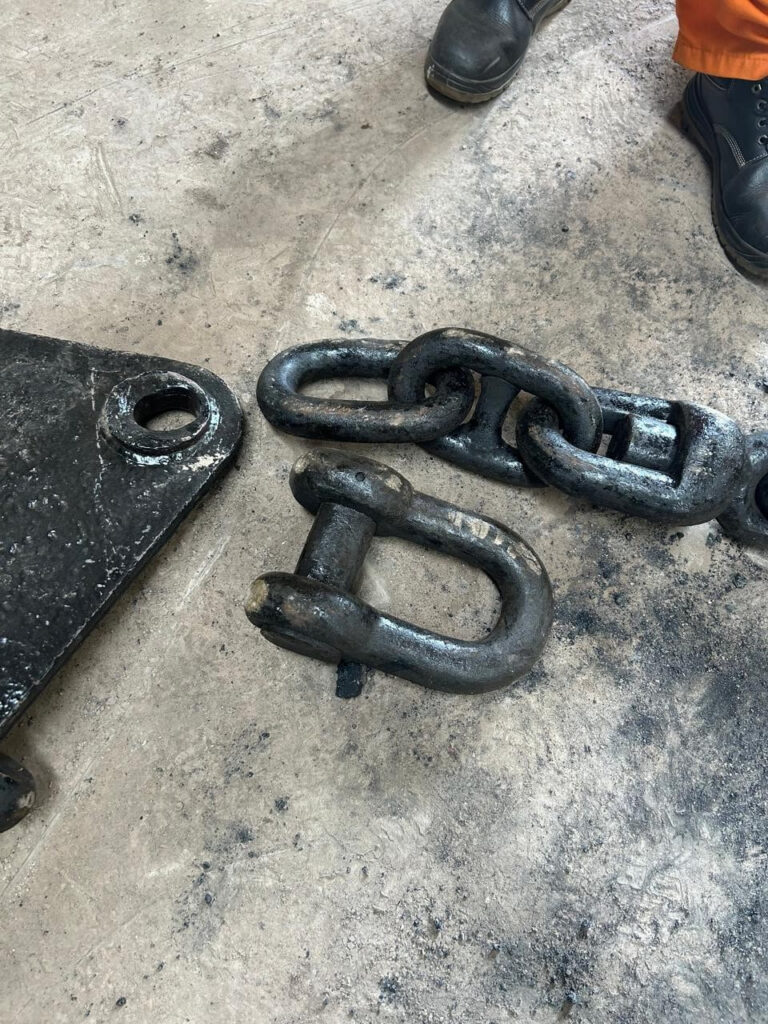 Chain accessories
Swivel forerunner
The swivel forerunner is the made-up assembly between the anchor shackle and the first shot of chain. It lets the cable rotate and shed turns, so the…
Read more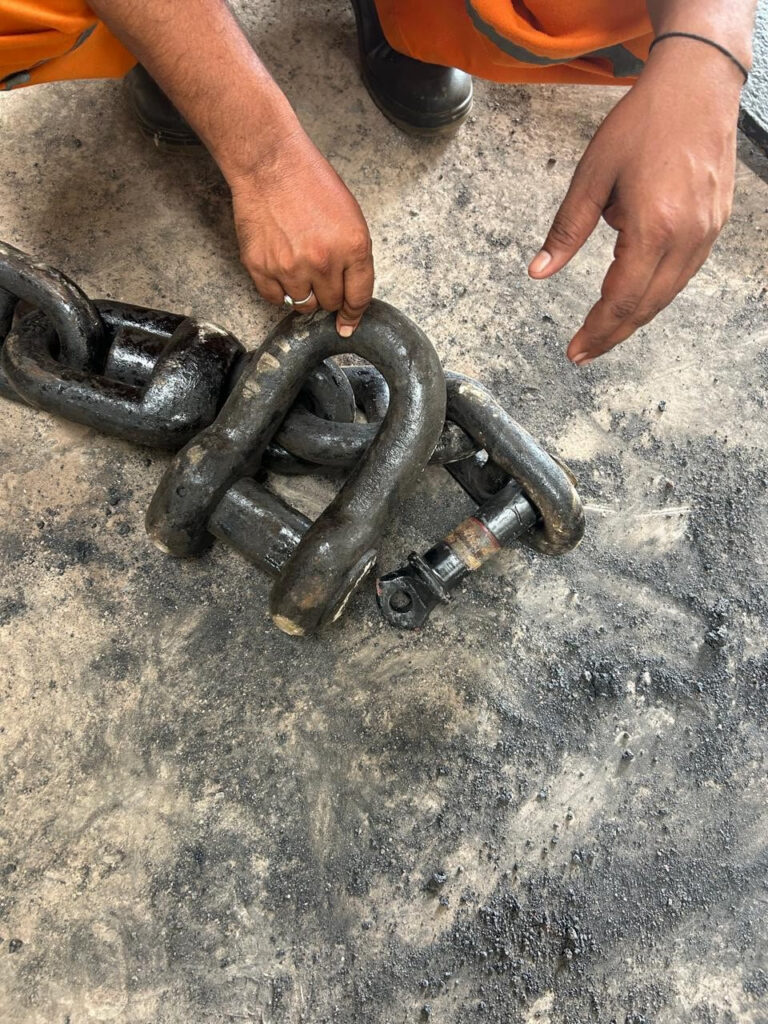 Anchor chain
Offshore mooring chain
Offshore mooring chain is a different product family from ship anchor chain — different grades, different steels, different approvals and a far…
Read moreTell us the diameter.
Send the diameter, the grade and the quantity — or the vessel’s Equipment Number if you are starting from scratch — and we will come back with availability and the certification package.