
Anchors
AC-14 HHP Anchor — High Holding Power Bower Anchor
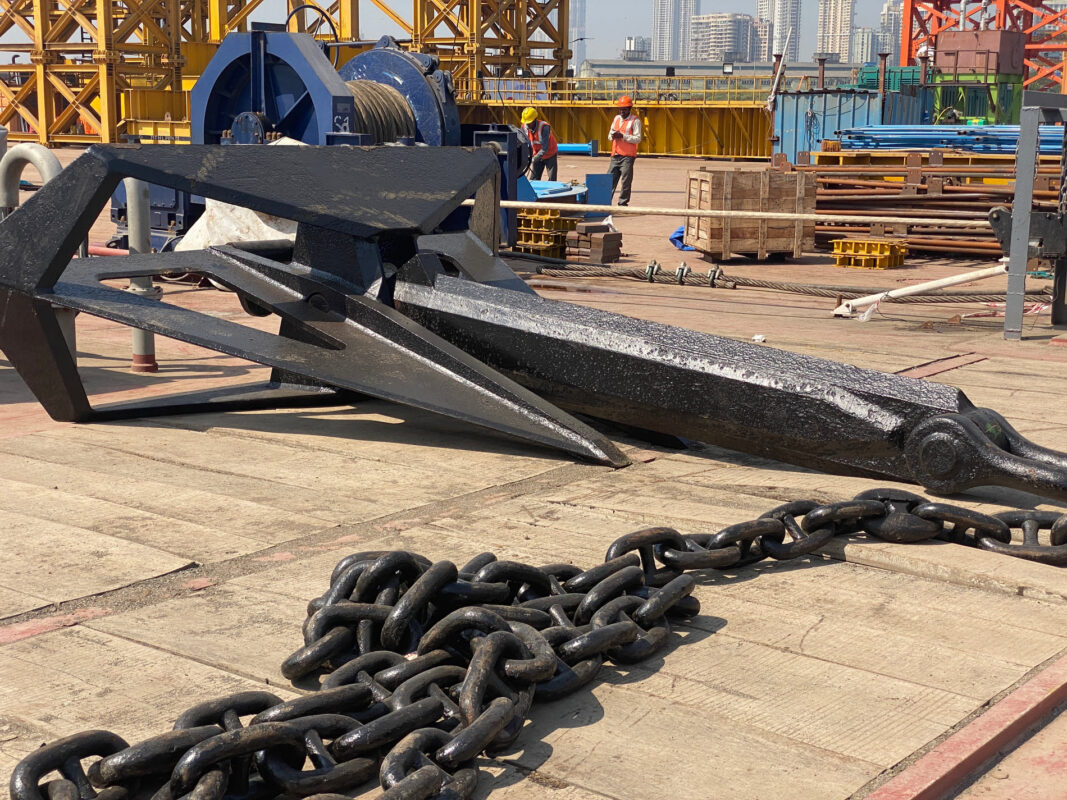
The AC-14 is the standard modern high-holding-power bower anchor: wide crown, long broad flukes, around 35° fluke angle. An approved AC-14 design may be supplied at 75 % of the ordinary-stockless mass, because it has to demonstrate twice the holding power in sea trials.
Why the AC-14 became the default
The AC-14 geometry puts a great deal more fluke area on the seabed for a given mass, with a wide crown that forces both flukes to trip together rather than letting the anchor lie on its side. That is what a holding-power trial actually measures, and it is why the pattern earns the mass reduction where earlier stockless designs do not.
For a shipowner the consequence is straightforward. A smaller anchor means a smaller hawse pipe, a smaller stowage recess, less hoisting effort and often a smaller windlass — for the same anchoring performance the class table asks for.
What “high holding power” actually requires
This is the part most commonly misstated, so it is worth setting out exactly:
- The anchor must hold with at least twice the holding power of an ordinary stockless anchor of the same mass.
- It must do so without prior adjustment or special placement on the sea bottom — no setting it by hand.
- Proof is by full-scale sea trials, three tests per anchor on each nature of bed, with the pull measured by dynamometer or from a tug’s bollard-pull curve, at a scope of about 10 and never less than 6.
- At least two anchor sizes must be tested, and the approval then extends only up to ten times the mass of the heaviest size actually tested.
- An approved anchor is then proof-tested at the load for 1.33 × its actual mass — a stiffer test than an ordinary stockless anchor of the same weight receives.
All of that attaches to a named design. It does not transfer to a similar-looking anchor from another source, which is why the type-approval certificate has to be produced and matched.
Super high holding power
A further class exists for anchors demonstrating at least four times the holding power of an ordinary stockless anchor, or twice that of an already-approved HHP anchor. It carries a 50 % mass reduction, but is restricted: generally to vessels of restricted service, generally to anchors up to about 1,500 kg, with trials on three specified bottom types — soft mud or silt, sand or gravel, and hard clay — and three anchor sizes. It is not a general-purpose alternative to the AC-14.
Specification
Standard anchor mass series — ordinary stockless and the HHP equivalent
Every size in the series. Scroll sideways on a phone.
| Ordinary stockless anchor mass kgIACS UR A1 Table 1 | Approved HHP equivalent kg75 % of Table 1 mass | Min. head mass, ordinary stockless kg≥ 60 % of total |
|---|---|---|
| 180 | 135 | 108 |
| 240 | 180 | 144 |
| 300 | 225 | 180 |
| 360 | 270 | 216 |
| 420 | 315 | 252 |
| 480 | 360 | 288 |
| 570 | 428 | 342 |
| 660 | 495 | 396 |
| 780 | 585 | 468 |
| 900 | 675 | 540 |
| 1020 | 765 | 612 |
| 1140 | 855 | 684 |
| 1290 | 968 | 774 |
| 1440 | 1080 | 864 |
| 1590 | 1193 | 954 |
| 1740 | 1305 | 1044 |
| 1920 | 1440 | 1152 |
| 2100 | 1575 | 1260 |
| 2280 | 1710 | 1368 |
| 2460 | 1845 | 1476 |
| 2640 | 1980 | 1584 |
| 2850 | 2138 | 1710 |
| 3060 | 2295 | 1836 |
| 3300 | 2475 | 1980 |
| 3540 | 2655 | 2124 |
| 3780 | 2835 | 2268 |
| 4050 | 3038 | 2430 |
| 4320 | 3240 | 2592 |
| 4590 | 3443 | 2754 |
| 4890 | 3668 | 2934 |
| 5250 | 3938 | 3150 |
| 5610 | 4208 | 3366 |
| 6000 | 4500 | 3600 |
| 6450 | 4838 | 3870 |
| 6900 | 5175 | 4140 |
| 7350 | 5513 | 4410 |
| 7800 | 5850 | 4680 |
| 8300 | 6225 | 4980 |
| 8700 | 6525 | 5220 |
| 9300 | 6975 | 5580 |
| 9900 | 7425 | 5940 |
| 10,500 | 7875 | 6300 |
| 11,100 | 8325 | 6660 |
| 11,700 | 8775 | 7020 |
| 12,300 | 9225 | 7380 |
| 12,900 | 9675 | 7740 |
| 13,500 | 10,125 | 8100 |
| 14,100 | 10,575 | 8460 |
| 14,700 | 11,025 | 8820 |
| 15,400 | 11,550 | 9240 |
| 16,100 | 12,075 | 9660 |
| 16,900 | 12,675 | 10,140 |
| 17,800 | 13,350 | 10,680 |
| 18,800 | 14,100 | 11,280 |
| 20,000 | 15,000 | 12,000 |
| 21,500 | 16,125 | 12,900 |
| 23,000 | 17,250 | 13,800 |
| 24,500 | 18,375 | 14,700 |
| 26,000 | 19,500 | 15,600 |
| 27,500 | 20,625 | 16,500 |
| 29,000 | 21,750 | 17,400 |
| 31,000 | 23,250 | 18,600 |
| 33,000 | 24,750 | 19,800 |
| 35,500 | 26,625 | 21,300 |
| 38,500 | 28,875 | 23,100 |
| 42,000 | 31,500 | 25,200 |
| 46,000 | 34,500 | 27,600 |
Where these numbers come from. Masses are the standard series of IACS UR A1 Table 1, selected from a vessel’s Equipment Number. An anchor of approved high-holding-power design may be 75 % of the tabulated mass, because it must demonstrate at least twice the holding power of an ordinary stockless anchor of equal mass in full-scale sea trials. Proof loads are set by UR A1 Table 2 and appear on the anchor’s certificate — an HHP anchor is proof-tested at the load for 1,33 × its actual mass. Individual anchor mass may vary ±7 % provided the total for the outfit is met.
Documentation
What comes with the goods
- Type-approval certificate naming the approved design
- Works certificate — material, manufacture and heat treatment
- Proof-load certificate at the load for 1.33 × the actual anchor mass
- Post-proof crack examination, free head rotation, permanent set within 1 %
Tell us the class your vessel is being built or surveyed to and we will quote against it, with the certificates that class requires. If you are replacing a shot of chain or a single accessory, send us the diameter and the grade stamped on the end link and we will match it.
Frequently asked questions
How much weight does an AC-14 HHP anchor save?
An approved high-holding-power anchor is supplied at 75 % of the mass the class table gives for an ordinary stockless anchor — a 25 % reduction. On a 12,000 kg outfit that is 3,000 kg per anchor, which usually also reduces the hawse pipe, the stowage recess and the hoisting duty on the windlass.
What proves an anchor is high holding power?
A type-approval certificate from a classification society, granted after full-scale sea trials on several bottom types showing at least twice the holding power of an ordinary stockless anchor of the same mass, with at least two sizes tested. The certificate names the design. An anchor that merely resembles an approved design is not covered by that approval.
Is an AC-14 proof-tested differently?
Yes, and harder. An approved HHP anchor is proof-tested at the load corresponding to 1.33 times its actual mass, rather than at the load for its own mass. That is the counterweight to the 25 % mass reduction — the anchor is smaller, so it is tested more severely.
Can an HHP approval cover any size?
No. An approval extends only up to ten times the mass of the heaviest size actually sea-trialled. Beyond that the design has to be trialled again at a bigger size before the approval reaches further.
Related
 Anchors
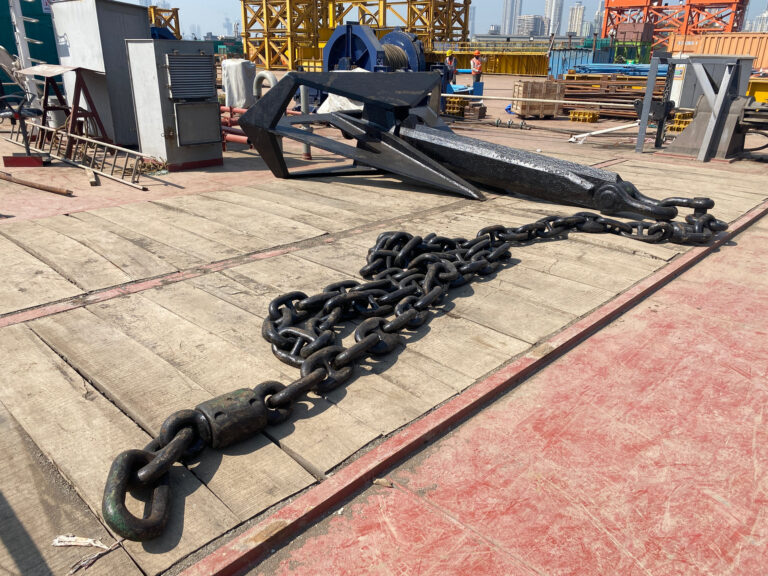
Hall anchor
The Hall is the plain stockless bower anchor: two arms hinged at the crown, no stock, and a shank that draws straight into the hawse pipe. It carries…
Read more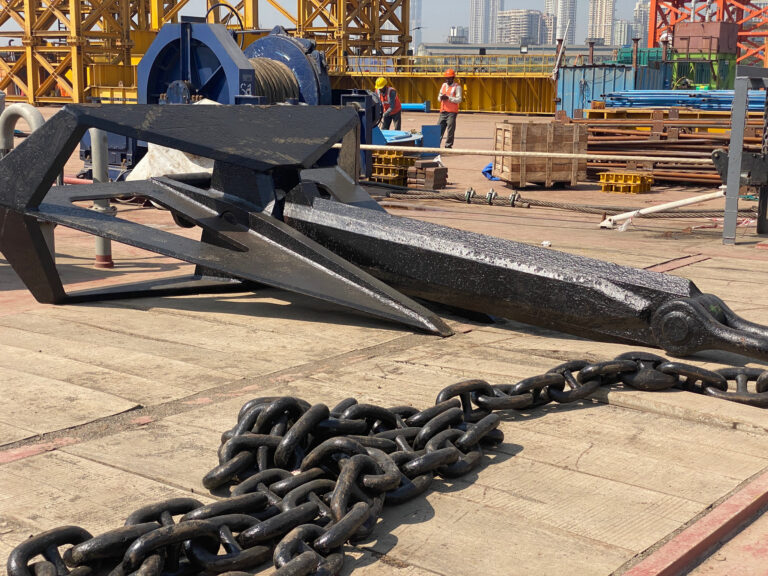 Anchors
Spek anchor
The Spek is a stockless bower anchor with a broad flat crown and slender pointed flukes — a development of the Hall aimed at better tripping and…
Read more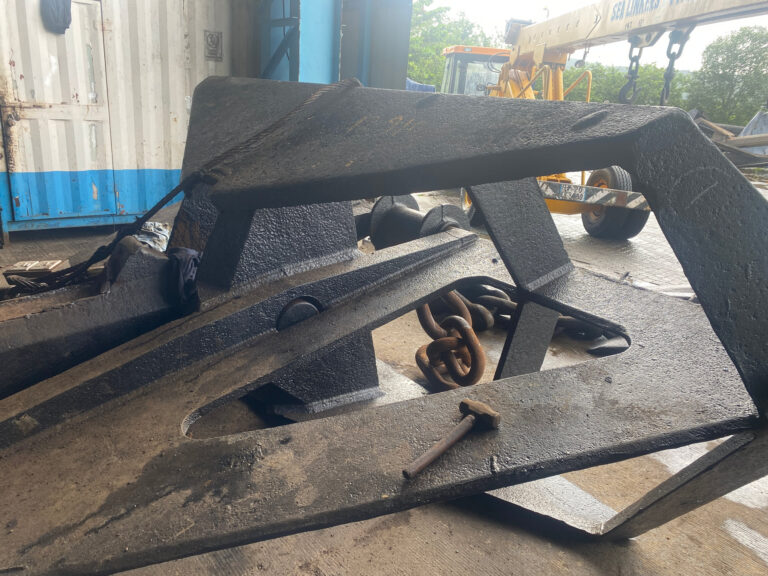 Anchors
Other HHP patterns
Beyond the AC-14 sit two families of high-holding-power stockless anchor: fully balanced cast patterns, and plate-built delta fluke designs. Both are…
Read more Reference
Class certification
In India the commercial gate on anchors and chain is class, and for most Indian-flag tonnage that means IRS. This page sets out what the…
Read moreGuides
Tell us the diameter.
Send the diameter, the grade and the quantity — or the vessel’s Equipment Number if you are starting from scratch — and we will come back with availability and the certification package.