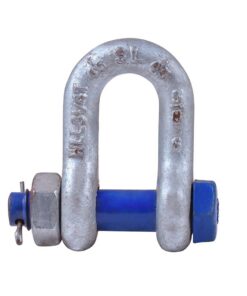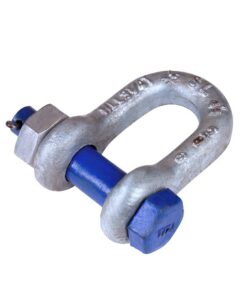
Shackles are the connectors that hold a lifting system together, and this category covers our own Sealinkers range of bow and dee shackles alongside the Crosby range we distribute. Between the two you can match almost any duty, from general fabrication work to certified lifting sets for ports, shipyards and offshore contractors.
The first decision is shape. A dee (or D) shackle is compact and strong for straight, in-line pulls; a bow shackle’s rounded body accepts multiple sling legs or side-angled loads without point-loading the pin. Our bow versus dee shackle guide sets out when each earns its place. The second decision is the pin: a screw pin is quick for rigging that is assembled and broken down often, while a bolt-type (nut and cotter) pin is the safer choice for long-term or semi-permanent installations where vibration could back a screw pin out.
Size by working load limit, never by pin diameter alone, and check that the shackle body sits fairly in the hook or masterlink — a shackle loaded across its pin at an angle loses capacity. Shackles here are supplied against the scope of IS 5245 for general engineering use and EN 13889 for forged shackles, with Crosby items carrying their own catalogue ratings.
Because we run an in-house test house on site, any shackle we sell can be proof-loaded and issued with a test certificate for your lifting-gear register — a routine requirement for loose gear at Indian ports under the Dock Workers regulations, and cheap insurance anywhere else.
Buying questions
When should I use a bow shackle instead of a dee shackle?
Use a bow shackle whenever more than one sling leg gathers in the shackle, or when the load can pull at an angle to the shackle’s centreline — the rounded bow gives the legs room without point-loading. Use a dee shackle for a single, straight, in-line pull, where its compact body is at its strongest. If the loading direction is uncertain, the bow is the safer default.
Screw pin or bolt-type pin — which should I order?
Screw pin shackles suit rigging that is made up and broken down frequently: they are fast and simple, but the pin can work loose under vibration. Bolt-type shackles, secured with a nut and cotter pin, are the right choice for long-term connections, lifted loads that rotate, or anywhere the shackle stays in place between inspections. Many sites now standardise on bolt-type for permanent rigging.
Can you proof-test shackles and give a certificate?
Yes. Our in-house test house in Darukhana proof-loads shackles on our own test bed and issues the test and examination certificate for your lifting-gear register. This is standard practice for loose gear used at ports under the Dock Workers regulations, and many factory and project sites now require it for all certified lifting sets regardless of location.
When should a shackle be taken out of service?
Withdraw a shackle if the pin does not seat fully by hand, if the body or pin shows wear, nicks, gouges or stretch, if the crown is visibly worn or flattened, or if the markings — size, grade, WLL — are no longer legible. A shackle with a bent pin or opened-out body has been overloaded and must be scrapped, not straightened. Never replace a shackle pin with a bolt.