
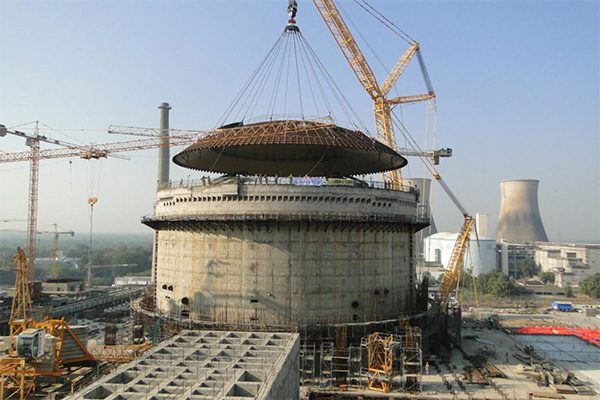
Nuclear Containment Dome Lifts: The Rigging Engineering Challenge
Placing the steel containment dome on a nuclear power plant is one of the most demanding single lifts in Indian heavy engineering — publicly documented examples include the dome placements at India’s indigenous pressurised heavy-water reactor units, such as those at the Kakrapar Atomic Power Station in Gujarat. While Sealinkers Pvt Ltd does not claim specific supply to any particular nuclear dome-lift project, our expertise in certified heavy-lift rigging and load-cell shackles is directly relevant to the class of challenge these lifts represent, and it’s worth understanding what makes them so difficult from a rigging standpoint.
Why a Dome Lift Is Different
A reactor containment dome is a single, enormous fabricated steel structure — typically pre-assembled on the ground beside the reactor building and lifted as one piece, rather than erected panel by panel like a conventional structure. That single-lift approach removes the risk of misaligned field welds at height, but it concentrates enormous engineering demands onto one lift: the rigging must handle a load far heavier than almost any other single lift on an industrial site, position it with millimetre-level accuracy onto a prepared ring at height, and do all of this without the option of a second attempt if something goes wrong partway through.
Rigging Considerations for Extreme Single Lifts
- Very high safety factors: Lifts of this consequence are typically engineered to well above the minimum safety factors used for routine lifting, with every sling, shackle and wire rope in the rigging chain individually certified and traceable.
- Load monitoring throughout: Load cells and load-monitoring shackles are used to track the actual load on each leg of the rigging in real time, catching any unexpected shift in load distribution — caused by the dome’s own structure flexing, or wind — before it becomes dangerous.
- Multi-crane coordination: Loads of this scale often exceed the capacity of a single crane and require synchronised multi-crane or heavy-lift-system operations, where the rigging plan must account for how load shifts between cranes throughout the lift, not just at the final resting point.
- Weather windows: A dome lift is typically only attempted within a narrow wind-speed window, since the dome’s large surface area makes it highly sensitive to gusts while suspended.
Where Certified Rigging Gear Fits In
Every component in a lift of this consequence — wire rope slings, shackles, master links, load cells — needs a valid, traceable test certificate, and in India that means gear tested by an in-house test house against IS 2266, EN 13414, and EN 1677 as applicable. Sealinkers’ own our in-house test house carries out exactly this kind of proof-load and NDT verification for heavy-lift rigging components; see our testing & certification page for the full scope.
For certified heavy-lift slings, load-monitoring shackles, or expert advice on planning an extreme-capacity lift, contact Sealinkers for a quote.
