
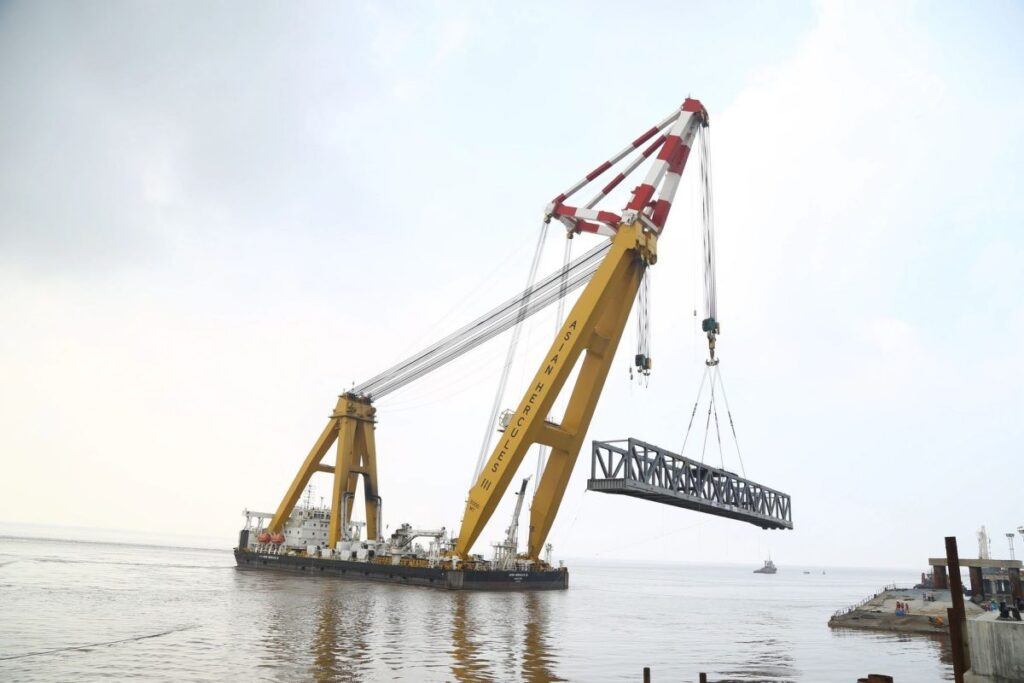
RoRo Ferry Bridge Lifts: Rigging a Linkspan
Roll-on/roll-off (RoRo) ferry terminals rely on a moving structure called a linkspan — a hinged steel ramp bridge that connects the fixed jetty to the ferry’s vehicle deck and adjusts for tide and vessel freeboard. Gujarat’s Ghogha–Dahej Ro-Pax route across the Gulf of Khambhat is a well-known public example of this kind of infrastructure, built to shorten a long road journey around the gulf into a much shorter sea crossing. While Sealinkers Pvt Ltd does not claim specific supply to any particular RoRo terminal project, our expertise in heavy-lift rigging and marine-grade wire rope is directly relevant to the engineering challenge a linkspan installation represents.
Why a Linkspan Is a Rigging Challenge
Unlike a fixed bridge span, a linkspan has to be installed as a working hinged mechanism, not just a static structure. The main ramp span — a large fabricated steel structure — is typically lifted into place and pinned onto shore-side hinges in one operation, meaning the rigging has to hold the load steady and level while the hinge pins are aligned and driven, with essentially no tolerance for the load twisting or swinging during that final positioning.
Rigging Considerations Specific to Marine Terminal Lifts
- Level control across multiple lift points: A ramp span is typically rigged from several points simultaneously, and keeping the load level throughout the lift — not just at the final position — requires careful sling-length matching and, often, real-time load monitoring at each point.
- Marine-grade corrosion protection: Rigging gear used at a coastal or tidal site is exposed to salt air throughout the project, so galvanised or stainless wire rope and hardware, properly lubricated per our lubrication guide, matters even during the construction phase, not just for the finished structure.
- Tidal and weather windows: Like most marine lifts, the actual pick-and-place window is constrained by tide levels and sea conditions, so the rigging plan needs to be executable within a tight, predictable time window rather than an open-ended one.
- Working over water: Rigging plans for over-water lifts typically build in extra contingency — for the load, for personnel safety, and for equipment recovery — that a purely land-based lift doesn’t need to consider.
Where Certified Rigging Gear Fits In
Marine infrastructure lifts depend on wire rope, slings, and shackles that carry valid, in-date test certificates — proof-load tested to IS 2266 and EN 13414 by an in-house test house — precisely because the consequence of a rigging failure over open water is so much higher than on dry land. Sealinkers’ own in-house test house carries out this kind of certification; see our testing & certification page for details.
For certified marine-grade rigging gear or expert advice on a coastal lifting project, contact Sealinkers for a quote.
