
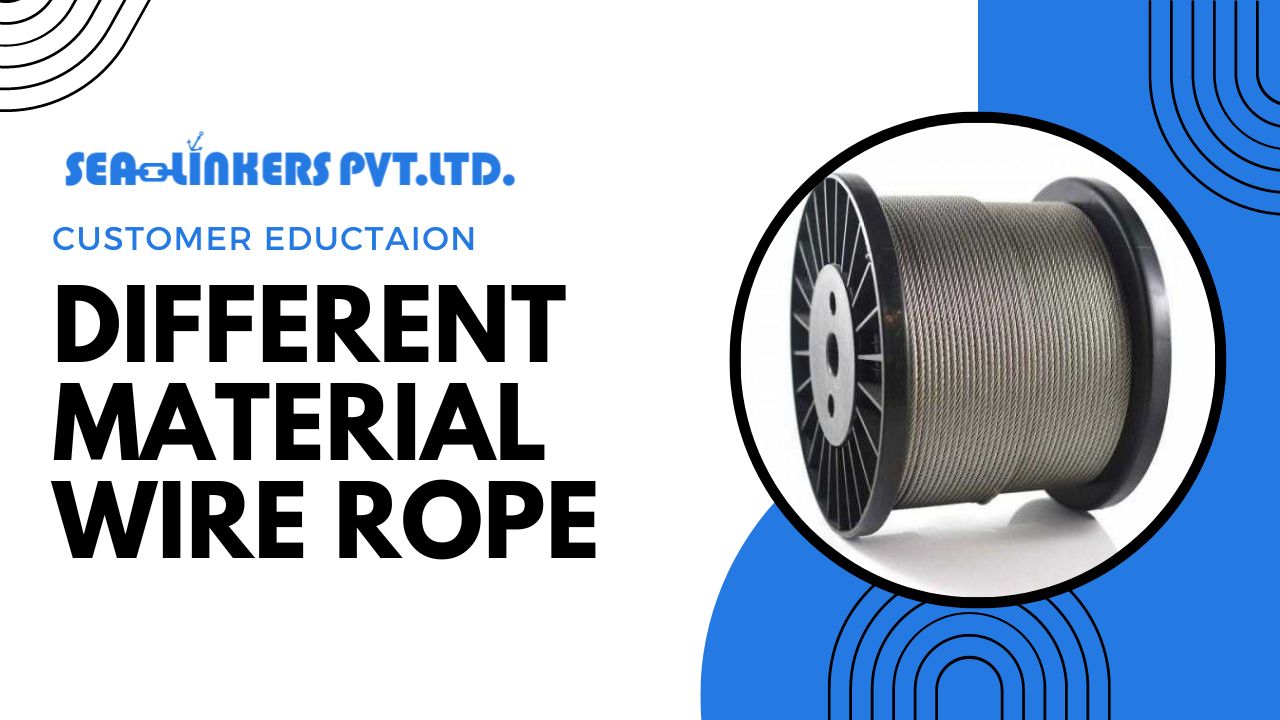
Wire Rope Materials, Finishes & Coatings
Wire rope is specified by three linked choices: the wire finish (bright, galvanised or stainless steel), the core (fibre or independent wire rope core), and any outer coating such as PVC. Bright suits dry indoor duty, galvanised suits outdoor and marine work, stainless suits corrosive environments — and the core decides crush resistance and strength.
Selecting the right wire rope involves considering the material, finish, and core type to suit your specific environment and application. These factors significantly impact the rope’s performance, durability, and safety. Most general-engineering wire rope, including the range we stock, is manufactured to a wire grade of 1960 N/mm² under IS 2266 — India’s standard for steel wire ropes for general engineering purposes.
Materials and finishes
- Bright (Un-galvanised): Ideal for general-purpose applications where corrosion is not a major concern. It offers good strength but requires regular lubrication to prevent rust — see our lubrication guide.
- Galvanised: Provides excellent corrosion resistance. There are two main types: drawn galvanised (galvanised before drawing to final wire size) and galvanised at final size. The latter offers better surface protection but may have slightly lower strength due to hydrogen embrittlement risks during manufacturing.
- Stainless Steel: Used in highly corrosive environments, such as marine or chemical industries. It offers superior corrosion resistance but is more expensive, and generally has a lower breaking strength than an equivalent-diameter carbon-steel rope of the same construction.
The finish decision is fundamentally an environment decision. Bright rope in a dry, ventilated indoor plant, kept lubricated, gives the best strength for money. The moment the duty moves outdoors — and in coastal India, “outdoors” includes anything the monsoon can reach — galvanising earns its premium many times over in service life. Stainless steel is the specialist’s answer: chosen not for strength but for survival in chloride-rich, chemical or wash-down environments where even zinc coating is consumed.
| Finish / coating | Corrosion resistance | Relative strength | Relative cost | Typical applications |
|---|---|---|---|---|
| Bright (ungalvanised) | Low — depends entirely on lubrication | Highest for a given grade and construction | Lowest | Indoor cranes, hoists, workshops, general rigging in dry conditions |
| Galvanised | Good — zinc layer sacrificially protects the steel | Comparable to bright; final-size galvanising may give up a little strength | Moderate | Outdoor cranes, marine and dock work, guy ropes, monsoon-exposed plant |
| Stainless steel | Excellent, including chloride and chemical exposure | Generally lower than equivalent carbon-steel rope | Highest | Chemical plants, food processing, offshore splash zones, architectural rigging |
| PVC / plastic coated | Substrate protected while coating is intact | As per the underlying rope | Moderate (over base rope) | Food contact, high-visibility safety lines, insulation, protecting adjacent surfaces |
Coatings
Plastic or PVC coatings can be applied to wire ropes for additional protection and visibility. They are useful in environments where the rope might come into contact with food products, where electrical insulation is a concern, or where high visibility is required for safety around moving machinery. The trade-off is inspectability: a coating hides the wire surface, so broken wires and corrosion can develop unseen beneath an intact jacket, and once the coating is cut or abraded through, moisture trapped underneath can corrode the rope faster than if it had no coating at all. Coated ropes belong in applications chosen for the coating’s benefits — not as a substitute for corrosion-resistant wire in lifting duty.
Core types
The core of the rope affects its flexibility and strength. Fibre Cores (FC) offer more flexibility and cushioning, making them suitable for applications involving smaller sheaves and drums, though they compress over time under sustained load. Independent Wire Rope Cores (IWRC) provide greater strength — typically 7-10% more breaking strength than an equivalent FC rope — and far better resistance to crushing, making them the standard choice for heavy-duty lifting, crane, and mining applications where the rope is spooled onto a drum under load. The core also interacts with the finish choice: an IWRC is steel through the middle of the rope, so in corrosive service it needs the same protection as the outer wires — a reason galvanised IWRC ropes are specified for marine work, and a reason internal lubrication matters so much (see our wire rope lubrication guide).
Indian standards, certification and our experience
IS 2266 is the governing Indian standard for steel wire ropes for general engineering purposes — it covers the constructions, grades and finishes in which compliant rope is supplied. In service, IS 3973 takes over, covering care, maintenance, inspection and discard, and for crane ropes ISO 4309 is the internationally recognised equivalent discipline. Finish choice feeds directly into that in-service story: the discard criteria for corrosion arrive much sooner on a bright rope in the wrong environment than on a correctly specified galvanised one. Our wire rope inspection checklist covers what the competent person looks for.
Sealinkers has supplied and tested wire rope from Darukhana, Mumbai since 1977, and operates as an in-house test house with a proof-load bed from 1 to 1,200 tonnes. On that bed, finish choices show their consequences: bright ropes from dockside duty arriving for examination with corrosion-driven diameter loss in a fraction of the life their galvanised equivalents give, and coated ropes whose jackets concealed the damage until the cover was stripped for examination. As an supplier, every rope we supply from the Usha Martin wire rope range comes with its mill test certificate stating grade, finish, construction and tested breaking force — the document your inspection regime will be checked against. See our Usha Martin partnership page for the full programme.
Selection checklist
SELECTION CHECKLIST
- Environment: dry indoor → bright; outdoor/marine/monsoon-exposed → galvanised; chemical, food or chloride-heavy → stainless.
- Duty: drum spooling under load or multi-layer winding → IWRC; light single-layer duty on small sheaves → FC acceptable.
- Strength: confirm the required minimum breaking force against the certificate, not a catalogue headline — see WLL vs SWL explained.
- Compatibility: match construction and finish to existing sheaves, drums and terminations.
- Coating: specify PVC only where its function (hygiene, visibility, insulation) is actually needed, and plan how the rope underneath will be inspected.
- Certification: insist on the mill test certificate with every supply, and file it with the rope’s inspection records.
Never substitute rope finishes or materials on strength assumptions. A stainless rope is not a like-for-like swap for a galvanised one of the same diameter — its breaking strength is generally lower — and a coated rope’s jacket can hide discard-level damage. Any substitution must be checked against the certificate values for the actual rope supplied, and the lifting equipment’s documentation updated accordingly.
Frequently asked questions
Is galvanised wire rope weaker than bright rope?
A drawn-galvanised rope is generally comparable in strength to bright rope, because the wire is drawn to final size after coating. Rope galvanised at final size can give up a small amount of strength for its thicker, more protective zinc layer. In either case, the mill test certificate for the specific rope states its actual breaking force — specify from that, not from an assumption.
When is stainless steel wire rope worth the cost?
When the environment would destroy anything else: chemical plants, food and pharmaceutical processing with aggressive wash-downs, offshore splash zones, and permanent architectural installations where re-roping is expensive. For ordinary outdoor lifting in India, galvanised rope with a proper lubrication regime is usually the more economical engineering answer.
Does a PVC coating make a rope safer?
It makes the rope safer for what it touches — food products, painted surfaces, hands — and more visible. It does not make the rope itself stronger or more durable, and it makes inspection harder because the wires are hidden. For lifting duty, corrosion protection should come from the wire finish (galvanised or stainless), not from a plastic jacket.
How do I know which finish my existing rope has?
Start with the certificate — grade, finish and construction are stated on the mill test certificate supplied with the rope. Visually, galvanised rope has a matt grey zinc surface, bright rope is oiled steel that rusts quickly where the lubricant fails, and stainless keeps a uniform silvery surface. If a rope has no traceable certificate, treat that as a finding in itself and have it examined before further use.
Which combination should I default to for outdoor lifting in India?
A galvanised IWRC rope is the common default for outdoor and marine lifting work where both corrosion resistance and crush resistance matter. A bright FC rope suits lighter indoor lifting where cost and flexibility matter more than corrosion resistance. Stainless steel is reserved for environments — chemical plants, food processing, offshore splash zones — where even galvanising isn’t enough.
Related reading
Finish and core are two of the three choices — the third is construction, covered in our wire rope construction guide. For certified supply across all these combinations, browse Usha Martin wire ropes and ready-terminated wire rope slings, or contact Sealinkers for expert advice and a quote tailored to your needs.
