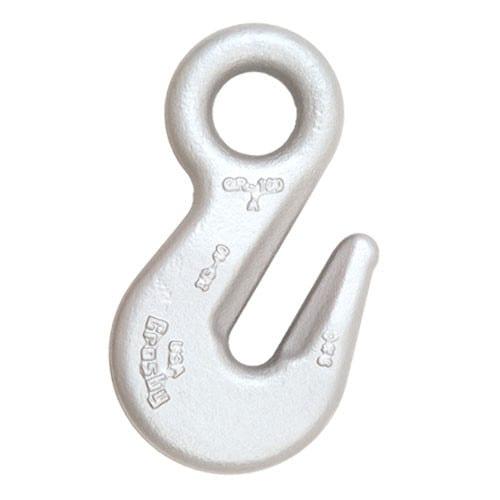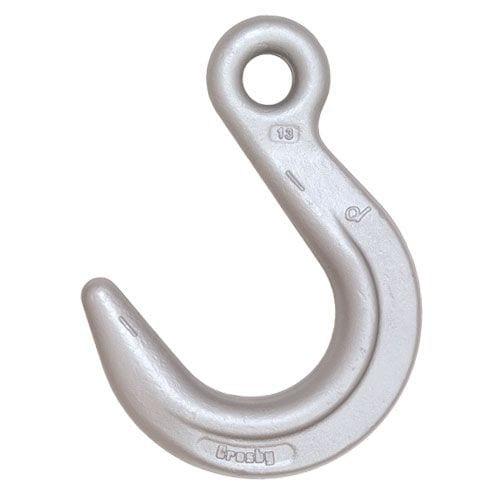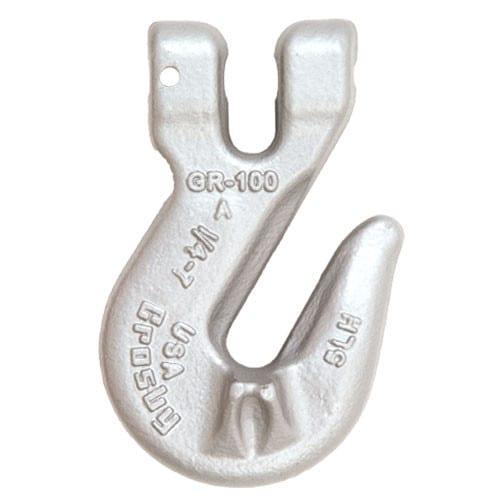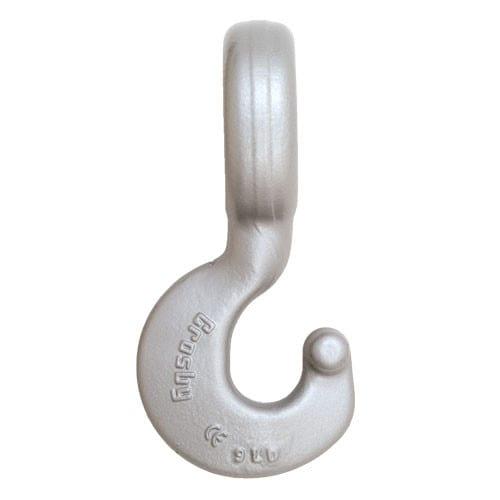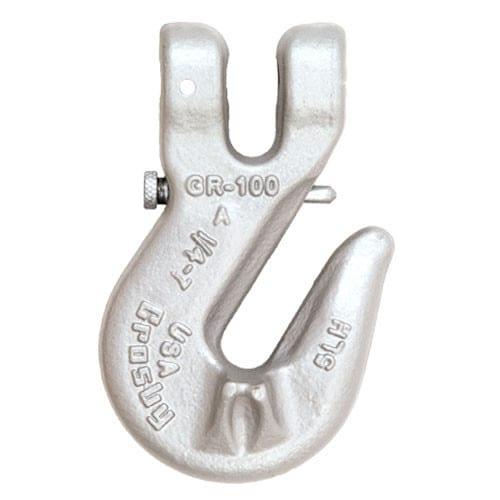
Crosby L-1338 Grade 100 Locking Clevis Grab Hook
In Stock 5 sizes available
Crosby 9/32" (1/4") L-1338 Grade 100 Locking Clevis Grab Hook - 4300 lbs WLL - #1049480
SKU: CR-1049480
Reply within 24 hours. Formal quotation within 48 hours. Supplying since 1977.
Call +91 93729 19606(Mon to Sat, 9 am to 6 pm IST)
All sizes (5)
All sizes as a PDF| Size | WLL | SKU | |
|---|---|---|---|
| 9/32" | 1.95 t | CR-1049480 | |
| 5/16" | 2.59 t | CR-1049489 | |
| 3/8" | 3.99 t | CR-1049498 | |
| 1/2" | 6.8 t | CR-1049507 | |
| 5/8" | 10.25 t | CR-1049516 |
Pricing for registered businesses
Sign in to view live prices, or register free — approval usually within 1 business day.
Test certificate with every supply
In-house 1,200 T test bed
Genuine Products
Request a Quote for this Product
Get a formal quotation within 48 hours.
Overview
Crosby L-1338 Grade 100 Locking Clevis Grab Hook, working load limit 1.95 t to 10.3 t, 5 sizes.
Full Description
The Crosby L-1338 Cradle Clevis Grab Hook offers the same high-strength performance as the A-1338 model with the added security of a locking pin mechanism. Unlike standard grab hooks, this lockable design prevents accidental disengagement, ensuring greater safety during lifting and rigging operations.
Key Features:
Forged Alloy Steel Construction – Quenched and tempered for superior strength and durability.
Cradle (Saddle) Design – Prevents chain link deformation and allows 100% efficiency of Grade 100 chain.
Locking Pin Mechanism – Secures the hook in place, preventing accidental chain disengagement.
Clevis Pin Attachment – Enables direct connection to Grade 100 or Grade 80 chain slings without additional links.
Individually Proof Tested – Rated at 2-1/2 times the Working Load Limit (WLL) with full certification.
Fatigue Rated – Tested at 1-1/2 times the WLL for 20,000 cycles for long-term durability.
Ultimate Load Capacity – Engineered to withstand 4 times the WLL for added safety.
Product Identification Code (PIC) – Each hook is traceable and marked with Crosby, U.S.A., and size information.
Safe Use Guidelines:
When hooking back to the chain leg for a choker hitch, ensure the choke angle is 120 degrees or greater.
When used as a chain shortener, minimize chain twist and ensure full engagement in the hook.
Signature Platinum Color – Easily identify Crosby Grade 100 Alloy Products at a glance.
With enhanced safety features and Crosby’s trusted quality, the L-1338 Cradle Clevis Grab Hook with Locking Pin is ideal for critical lifting applications where load security is a priority. Order today for a reliable and high-performance chain attachment solution!
Prices, stock and lead times on request. Every item can be supplied with a test certificate; proof-load testing in our own test house on request.
Choosing and using a lifting hook
A hook is rated for a load that sits in its bowl, in line with the shank. Loading the tip, pulling the hook sideways, or spreading two sling eyes across the bowl all bend a section that was designed for straight tension, and the rating no longer holds.
The shape is matched to the job: sling and hoist hooks for general lifting, self-closing and locking hooks where a load must not come free, grab hooks for shortening or holding chain, and foundry, sorting and barrel hooks for the handling their names describe.
Choosing the right one
- Grade and fitting matched to the chain or sling it goes on. A Grade 80 hook on Grade 100 chain limits the whole leg to Grade 80.
- Eye, clevis or shank attachment to suit the connection; clevis hooks pin straight onto chain of the matching size.
- A latch or a self-locking design wherever a slack sling could jump out of the bowl.
- Grab hooks hold a chain link in the throat; they are not for carrying a load in the bowl.
Check before every use
- Throat opening not stretched; compare it with the maker’s reference marks or a gauge.
- No twist, bend, cracks, nicks or gouges, and no wear in the bowl.
- Latch closes on its own; swivel hooks turn freely.
- Any hook that has been heated, welded or straightened comes out of service.
Ratings, dimensions and limits for this exact item come from the maker’s data shown on this page.