Grade 80 vs Grade 100 Chain: Which Do You Need?
Grade 100 chain carries roughly 25% more Working Load Limit than Grade 80 at the same link diameter — 25 to 27 % across the published size ladder, comparing EN 818-2 Grade 8 values with makers' Grade 100 tables — at a higher purchase price. Choose Grade 80 as the general-purpose default; step up to Grade 100 where headroom, chain weight or an existing sling's physical size is a genuine constraint.
The Core Difference
Alloy steel lifting chain is graded by minimum tensile strength under EN 818, and the two grades you will encounter most often — Grade 80 and Grade 100 — are not interchangeable on the same rated tag. Grade 80 (also written Grade 8) chain has a minimum tensile strength of 800 N/mm². Grade 100 chain steps that up to a minimum of 1000 N/mm² — roughly 25% stronger for the same link diameter. In practice that means a Grade 100 chain sling can carry meaningfully more load than a Grade 80 sling of identical size, or the same rated load in a noticeably lighter, more compact chain.
Both grades are quenched-and-tempered alloy steel, both are proof-loaded before release, and both must be assembled with components of a matching grade. The grade number changes the arithmetic of the lift; it does not change the discipline around it.
| Property | Grade 80 (G80) | Grade 100 (G100) |
|---|---|---|
| Material | Alloy steel, quenched and tempered | Premium alloy steel, quenched and tempered |
| Minimum tensile strength | 800 N/mm² | 1000 N/mm² |
| WLL for 10 mm chain | 3.15 t (EN 818); 3.2 t under IS 2760 | 4.0 t (maker's table; 25% higher than EN Grade 8) |
| Breaking strength (10 mm) | Minimum 12.6 t — 4 × WLL, the design factor of 4 used for Grade 8 chain slings (EN 818-4) | Minimum 16.0 t — 4 × WLL, the same design factor of 4 |
| Standard | EN 818-2 (Grade 8), ASME B30.9; IS 6215 in India | EN 818-2 covers Grade 8 only. Grade 100 chain is supplied to PAS 1061 / the maker's specification, with EN 1677 components; no Indian Standard covers it |
| Weight saving | Baseline | ~20% lighter for the same WLL |
| Best for | General overhead lifting, workshops, warehouses | Weight-critical lifts, offshore platforms, tight headroom |
Working Load Limit by Diameter
The practical difference shows up directly in single-leg vertical Working Load Limit (WLL), in tonnes:
| Chain diameter | Grade 80 WLL (EN 818-2 / EN 818-4) | Grade 100 WLL (typical maker's table) |
|---|---|---|
| 8 mm | 2.0 t | 2.5 t |
| 10 mm | 3.15 t | 4.0 t |
| 16 mm | 8.0 t | 10.0 t |
| 20 mm | 12.5 t | 16.0 t |
The Grade 80 column is the EN 818 regime; IS 2760 rates the same sizes slightly differently (10 mm Grade T(8) is 3.2 t there, not 3.15 t) and uses its own size ladder, so an IS-certified sling may carry a figure that differs from this table. The Grade 100 column follows published maker's tables and varies between makers. Always work from the sling's own rated tag and certificate before use, never from a table in an article. Multi-leg slings and angled legs carry less than the sum of the leg WLLs; below 45° from horizontal, capacity loss accelerates, and below 30° is generally not recommended. You can check sizing for your specific load and sling angle with our free sling load calculator, and our WLL vs SWL guide explains what the tag figures actually mean.
When Grade 80 Is the Right Choice
Grade 80 is the general-purpose default across most industrial and construction lifting — widely available, well understood by riggers, and more than adequate for the vast majority of loads. Spares, replacement legs, hooks and shorteners are stocked everywhere, which matters when a sling comes off hire or fails inspection mid-project and needs a component swapped quickly. Unless there is a specific reason to step up, Grade 80 is usually the more cost-effective and readily stocked option, and it is the grade most Indian test certificates and tender specifications assume by default.
When Grade 100 Earns Its Premium
Grade 100 makes sense where diameter or weight is genuinely constrained: tight headroom that limits how large a chain assembly can fit, applications where the rigger has to manually carry and connect the chain repeatedly through a shift and every kilogram of sling weight matters, or where you need to raise the capacity of a lifting point without changing the physical envelope of the sling. A smaller-diameter Grade 100 chain matching a larger Grade 80 chain's WLL is also easier to reeve through confined lifting points. It typically costs more than Grade 80 for the same diameter, so the decision usually comes down to whether the space or weight constraint is real, not a preference for a higher grade number.
What Doesn't Change Between Grades
Both grades need connecting components (hooks, master links, shorteners) certified to EN 1677 to form a compliant assembly — the chain itself is made to EN 818 for Grade 80 and to the maker's specification for Grade 100 — see our guide to EN 818 and EN 1677 standards for the full picture. Inspection, discard criteria and periodic examination apply identically to both: grade does not change how often or how rigorously the sling needs to be examined. And critically, the components must match the chain: a Grade 100 chain terminated in Grade 80 hooks is rated as a Grade 80 assembly at best, and arguably as a non-compliant one.
Grade 80 and Grade 100 in the Indian Context
In India the chain standards are split by grade. Grade T(8) — the grade sold as Grade 80 — sits under IS 6215, while IS 3109 (Part 1) covers Grade M(4)/40 short-link chain; finished chain slings are covered by IS 2760 (steel chain slings). IS 2760 specifies a proof load of twice the safe working load; the 4:1 design factor quoted above is the EN 818-4 figure, not an Indian one. There is no Indian Standard for Grade 100 chain: IS 2760 caps the series at Grade T(8)/80, so a Grade 100 sling supplied in India is certified to the maker's specification, not to an IS. Imported chain sold here is usually certified to EN 818 with EN 1677 components, and Indian test houses accept and reference both families — what matters to the inspector is that the certificate, the markings on the links, and the tag all agree on grade and WLL.
Under section 29 of the Factories Act, 1948, every chain and lifting tackle must be thoroughly examined by a competent person at least once in every period of twelve months (s.29(1)(a)(iii)), with the results entered in the register — in a factory that competent person is recognised by the state Chief Inspector of Factories, and at ports, under the Dock Workers (Safety, Health and Welfare) Regulations 1990, by DGFASLI. That is the framework our DGFASLI compliance guide covers in detail. The grade on the tag has no bearing on that obligation.
As an in-house test house operating in Darukhana, Mumbai since 1977, we proof-load chain slings on our own test bed — rated from 1 to 1,200 tonnes — before they leave our premises, and we re-test and certify third-party chain slings brought in for periodic examination. One pattern we see repeatedly on the test floor: slings presented as "Grade 100" where the master link or hooks are stamped Grade 8. The chain may be genuine G100, but the assembly cannot be certified at G100 numbers, and the customer usually only discovers this when the certificate comes back at the lower rating.
- Confirm the actual load, sling angle and number of legs before comparing grades — calculate it, don't estimate.
- Check headroom: if a Grade 80 assembly of the required WLL physically fits, the case for Grade 100 weakens.
- Verify every component (hooks, master links, shorteners) carries the same grade mark as the chain.
- Check the links for the embossed grade mark and the tag for WLL, grade and traceability details per EN 818 marking requirements.
- Insist on a test certificate naming the standard (EN 818 / IS 2760) and the assembly's WLL — not just the chain's.
- Budget for identical inspection and re-certification costs whichever grade you buy.
Never mix Grade 80 and Grade 100 components in one assembly and rate it at Grade 100 figures — the assembly is only as strong as its weakest-grade component. Never weld, repair or heat lifting chain: both grades are quenched-and-tempered alloy steel, and uncontrolled heat destroys the heat treatment invisibly. A chain that has been overloaded, shows stretched or nicked links, or has lost its tag must be quarantined and referred for examination — see our load testing guide for what re-certification involves.
Frequently asked questions
Can I mix Grade 80 and Grade 100 components in one sling?
Physically they often fit; legally and structurally you must rate the assembly at the lowest grade present, and most test houses will refuse to certify a deliberately mixed assembly at all. Keep grades uniform across chain, hooks, master links and shorteners.
How do I tell which grade a chain is by looking at it?
EN 818 requires a grade mark embossed on the links at intervals — typically an "8", "80" or "T" family mark for Grade 80 and a "10" or "100" family mark for Grade 100, with the exact symbol varying by manufacturer. Cross-check the link marks against the tag and the certificate; if any of the three is missing or disagrees, treat the sling as unidentified and withdraw it for examination.
Is Grade 80 the same thing as Grade 8?
Yes — "Grade 80" and "Grade 8" (or "T grade" in some older catalogues) refer to the same 800 N/mm² class of alloy chain. Grade 100 is likewise written Grade 10 in some component markings.
Does Grade 100 chain require different inspection from Grade 80?
No. Discard criteria — wear, stretch, nicks, gouges, twisted or bent links, corrosion — and the statutory examination regime under the Factories Act are the same for both grades. What changes is only the load arithmetic, never the inspection discipline.
Can either grade be used in hot environments like foundries?
Both grades are heat-treated alloy steel, and elevated temperatures reduce their WLL. For Grade 80 chain slings EN 818-4 allows the full WLL up to 200 °C, 90 % of it up to 300 °C and 75 % up to 400 °C. Grade 100 is not better on heat — makers restrict it more, and each publishes its own limit. Every manufacturer publishes a temperature derating table for their chain; consult it and the sling's certificate before any hot-work lift, and never use chain that has been exposed to unknown heat, since the damage is metallurgical and invisible.
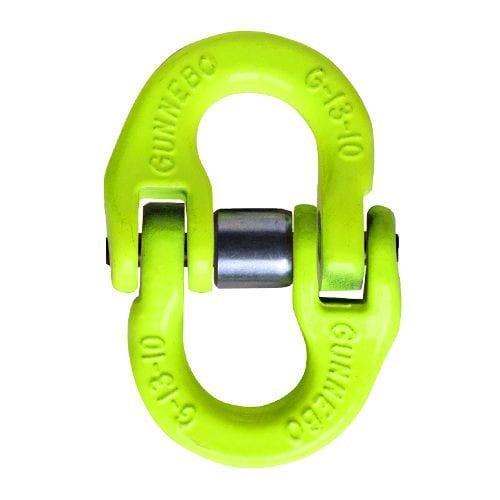
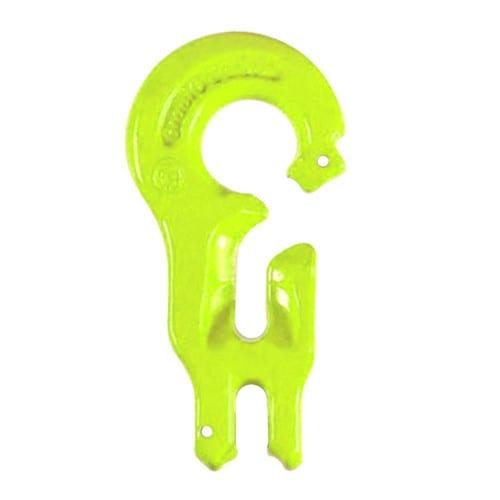
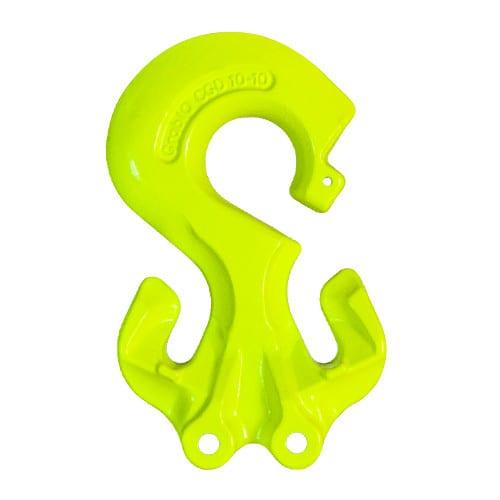
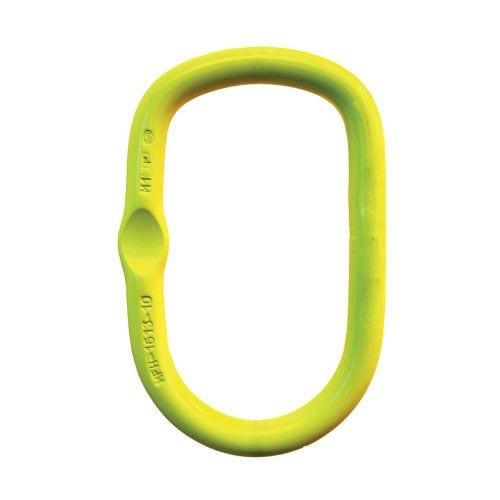
Sealinkers stocks Grade 80 and Grade 100 chain and chain slings — browse our chain slings and fittings, or read about the Gunnebo lifting components we supply. For help specifying the right grade and size for your load, contact our team for a quote.
Related Guides
Ready to put this into practice?
Every item ships certified, and our in-house test house backs it with the paperwork.
Sealinkers Engineering
Rigging & Lifting Engineering Team
Sealinkers has supplied and certified rigging, lifting and mooring equipment from Darukhana, Mumbai since 1977. These guides are written and checked by the engineers who specify this gear and proof-load it on our own test bed.
- in-house test house — proof-load bed from 1 to 1,200 tonnes
- Proof-load testing and certification in-house since 1977, Darukhana, Mumbai
- Class-society interfaces: IRS, ABS, LRS and BV