When to Discard a Wire Rope: IS 3973 and ISO 4309 Criteria Explained
A wire rope is discarded when any single criterion in IS 3973 or ISO 4309 is reached — broken wires beyond the count the standard's table permits for that rope, measurable diameter loss, corrosion, deformation such as bird-caging or kinking, or heat damage. No one criterion is optional, and the worst finding governs: one failed check condemns the rope.
Why discard criteria exist
Wire rope does not fail without warning — it degrades progressively, and the governing documents exist to convert that degradation into an objective retire/retain decision. In India, IS 3973 is the code of practice for the selection, installation and maintenance of wire ropes, and its discard clause (clause 8) is the Indian reference for taking a rope out of service. Internationally, ISO 4309 does the same job for ropes on cranes and is the reference most class societies and multinational operators specify. Wire rope slings have their own code, IS 12735 (identical with ISO 8792), and at ports the Dock Workers (Safety, Health and Welfare) Regulations 1990 add a statutory test of their own. The philosophies align: inspect regularly, measure against defined limits, and discard when any limit is reached — never "one more lift".
The point every one of these documents makes forcefully is that discard criteria are individually sufficient. A rope with acceptable wire breaks but excessive diameter loss is condemned. A rope with perfect diameter but a single kink is condemned. Inspectors are not averaging a score; they are looking for the first disqualifying defect.
BIS now publishes IS 3973:2022. This guide cites the standard by clause and table and deliberately does not reproduce its numbers: read the permitted counts and limits from the current edition, or from ISO 4309, for the rope in front of you. A remembered number from an old edition is not an examination.
The main discard criteria
| Criterion | What the inspector looks for | Where the limit comes from |
|---|---|---|
| Broken wires | Visible wire breaks counted over reference lengths expressed as multiples of the rope diameter (not lay length), with breaks concentrated in one strand or at terminations treated far more severely | The broken-wire table in IS 3973 (clause 8) or ISO 4309 (Tables 3 and 4), read for the number of load-bearing outer wires and the lay type; IS 12735 clause 5.4 for slings; reg. 48(3) of the Dock Workers Regulations for dock work |
| Diameter reduction | Measured rope diameter compared with the rope's recorded new diameter, indicating internal wear, core deterioration or external abrasion | IS 3973 clause 8 assesses wear and corrosion together over a measured length; ISO 4309 Table 5; IS 12735 clause 5.4 for slings |
| Corrosion | External rusting, pitting and — more dangerous — internal corrosion revealed by opening the lay or by slack outer strands | Severity-based assessment per the standard |
| Deformation | Kinks, bird-caging (cage formation), core protrusion, waviness (IS 3973 calls it corkscrew deformation), flattening and crushing | Kinks and cage formation: immediate discard. Waviness: the measured limit in IS 3973 clause 8.1.4 and ISO 4309 |
| Heat damage | Discolouration, weld spatter, arcing marks, or lubricant burnt off | Discard on evidence of heat affecting the rope |
| Wear and elasticity loss | Flattened crown wires, reduced springiness, elongation of lay | Assessed together with diameter and break counts |
Broken wires: counting, not guessing
Wire breaks are the most quantified criterion. IS 3973 and ISO 4309 both define their reference inspection lengths as multiples of the rope diameter — 6d and 30d — and permit different numbers of visible broken wires over each. The count you are allowed depends on the number of load-bearing wires in the outer strands and on whether the rope is ordinary lay or Lang's lay; ISO 4309 further distinguishes the rope's duty and spooling. Slings are judged over a six-diameter length under IS 12735 clause 5.4. In dock work the statute is explicit: under reg. 48(3) of the Dock Workers (Safety, Health and Welfare) Regulations 1990, no wire rope may be used if, in any length of eight diameters, the visible broken wires exceed 10 % of the total number of wires. That is a different test from the standards' tables, not a stricter version of them, and at a port it is the binding one.
Breaks clustered in one strand, or at a termination such as a splice or ferrule, are treated far more severely than the same number distributed around the rope, because clustering signals localised fatigue. A broken strand — as opposed to broken wires — condemns the rope outright under IS 3973.
Practical counting discipline matters: run a cloth along the rope to snag protruding breaks, flex the rope where permitted to open breaks for viewing, and record positions so the next examination can detect the rate of increase. A rope producing new breaks quickly is closer to discard than the raw count suggests. Our wire rope inspection checklist sets out the routine step by step.
Diameter, corrosion, and what hides inside
Diameter is measured across the crowns at several positions and orientations, and compared with the rope's actual new diameter, not just the nominal figure — which is why the first measurement after installation belongs in the rope's record. A reducing diameter usually means the core is deteriorating or internal wear is consuming metal you cannot see. Internal corrosion is the most dangerous single condition in Indian coastal and monsoon service because the rope can look serviceable outside while the interior wastes away — which is why regular lubrication matters so much; our guide to the lubrication of wire ropes covers the practice. Slack outer strands, reduced diameter, and rust staining bleeding from the valleys are the external tells.
Deformation: usually an immediate condemnation
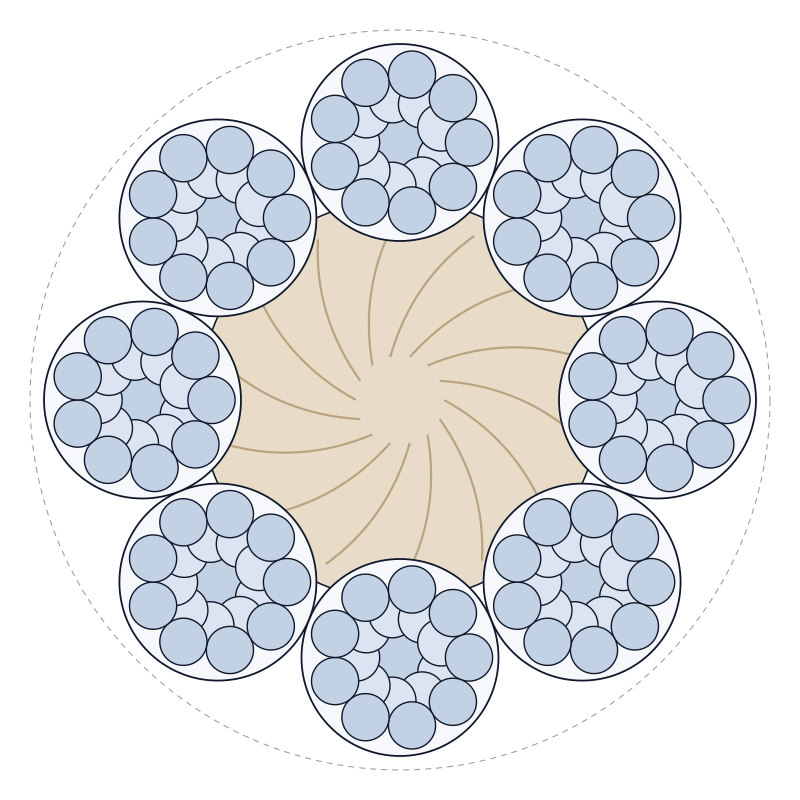
Mechanical deformation rarely comes with a measurement debate. A kink — a permanent distortion from a pulled-through loop — has destroyed the lay geometry at that point and the rope is condemned. Bird-caging, where outer strands balloon away from the core after sudden load release or torsion imbalance, is likewise a discard condition; see our dedicated article on bird-caging of wire rope. Core protrusion, crushing on drums, and pronounced waviness complete the list; waviness is the one deformation the standards measure rather than condemn on sight, so measure it against the clause rather than by eye. The construction of the rope influences its vulnerability here — the wire rope construction guide explains why fine-wire constructions resist bending fatigue but suffer more from abrasion and crushing.
Combining findings
ISO 4309 formalises what good inspectors always did informally: each degradation mechanism is assessed for severity, and the standard provides for combining findings so that several moderate conditions occurring together — say, wear plus corrosion plus some wire breaks — can jointly justify discard even where no single criterion has reached its individual limit. IS 3973 does the same for wear and corrosion, which it assesses together over a measured length rather than one at a time. ISO 4309 also ties the permitted broken-wire count to the rope itself through a Rope Category Number, so the count read from the table belongs to that rope construction and nothing else. If your crane or class society specifies ISO 4309, the examination record should show these assessments explicitly, not just "rope OK".
Indian compliance and the test-house view
For Indian sites the framework is layered. IS 3973 gives the technical discard criteria, IS 13367 is the code of practice for the safe use of cranes, and IS 12735 covers wire rope slings. The statutory duty to examine comes from the regime that applies to the site:
- Factories: under section 29(1)(a)(iii) of the Factories Act 1948, every chain, rope and lifting tackle is thoroughly examined by a competent person at least once in every period of twelve months, or at such intervals as the Chief Inspector specifies. The competent person is recognised by the state Chief Inspector of Factories.
- Ports and docks: under reg. 48(2) of the Dock Workers (Safety, Health and Welfare) Regulations 1990, every wire rope in use is inspected every three months, and every month once any wire in it has broken. The competent person is recognised by DGFASLI, acting as Chief Inspector of Dock Safety.
- Building and construction sites: the BOCW Central Rules 1998 apply, with the competent person recognised by the Central Government.
IS 3973 itself prescribes no inspection interval — every interval quoted to you should trace to the statute, the crane manual or the class society. Our guide to DGFASLI and Factories Act compliance sets the regimes side by side. Class-society surveys add their own examination points for marine cranes.
Sealinkers has run an in-house test house at Darukhana, Mumbai since 1977, with a 1,200 T proof-load test bed, and rope examination is daily work for us. Two field observations worth passing on: first, ropes are more often condemned for corrosion and deformation than for wire-break counts — neglected lubrication and shock loading kill more ropes in Indian service than honest fatigue. Second, when we supply Usha Martin wire rope, every length comes with its mill test certificate; keep it, because the examination regime and any future queries about actual new diameter start from that document.
Inspection checklist
- Confirm rope identity against its certificate: construction, nominal diameter, lay, core
- Measure diameter at several positions and orientations; compare with the recorded new diameter
- Count visible broken wires over the standard reference lengths — 6d and 30d for running ropes (IS 3973, ISO 4309), 6d for slings (IS 12735), 8d for anything used in dock work (reg. 48(3)) — and read the permitted count from the table for that rope
- Note clustering, breaks in the valleys between strands and breaks at terminations
- Check for corrosion — external pitting and any signs of internal corrosion at strand valleys
- Look for deformation: kinks, bird-caging, waviness, crushing, core protrusion
- Inspect terminations: splices, ferrules, sockets, and the rope immediately adjacent to them
- Check lubrication state and the sections that run over sheaves or spool in multiple layers most frequently
- Record findings quantitatively so the deterioration rate is visible at the next examination
Discard criteria are reached one at a time, but they condemn the whole rope. Never "downgrade" a condemned lifting rope to lighter lifting duty, and never cut out a damaged section and re-terminate for lifting service without the certification process that makes the shortened rope a new certified assembly. A rope that has reached discard on any criterion leaves lifting service — full stop.
Frequently asked questions
How often must wire ropes be inspected in India?
Ropes in lifting service get frequent in-service checks by the user, plus periodic thorough examination by a competent person: at least once every twelve months in a factory (Factories Act 1948, s.29(1)(a)(iii)), and every three months for every wire rope in dock work, dropping to every month once any wire in that rope has broken (Dock Workers Regulations 1990, reg. 48(2)). Severe environments — marine, corrosive, high duty cycle — justify shorter intervals than the statutory maximum.
How many broken wires condemn a rope?
There is no single number. The permitted count depends on the number of load-bearing wires in the outer strands, whether the rope is ordinary lay or Lang's lay, the reference length (six or thirty rope diameters) and, in ISO 4309, the rope's duty — that is exactly what the tables in IS 3973 and ISO 4309 exist for. What is universally true: breaks clustered in one strand or at a termination condemn a rope at far lower counts, and a broken strand condemns it outright.
Is IS 3973 or ISO 4309 the stricter standard?
The two share an ancestry and agree in philosophy; ISO 4309 is more elaborate on severity rating and on the rope's duty. If a contract, crane manual or class society specifies one, follow it. The real difference is at ports: there the statutory eight-diameter, 10 % test in reg. 48(3) of the Dock Workers Regulations applies whatever standard the examination follows, and it is a different test, not a stricter version of the same one — so satisfying ISO 4309 alone does not settle dock work.
Can a rope pass every measurement and still be condemned?
Yes. Evidence of heat damage, a kink, or contact with electrical arcing condemns a rope regardless of measurements, and ISO 4309's combined-severity approach can condemn a rope on several moderate findings together. The inspector's judgement, exercised within the standard, is part of the method.
Does lubrication really extend discard life?
Substantially. Lubrication suppresses both internal wear between wires and internal corrosion — the two mechanisms that condemn ropes invisibly. It is the cheapest life-extension measure available; see our wire rope inspection checklist and the lubrication guide for the working routine.
What should happen to a discarded rope?
Cut it so it cannot be returned to lifting service, mark it clearly, and dispose of it as scrap. Update the register and the rope history record. Condemned ropes reappearing on hooks is a recurring audit finding — physical destruction is the only reliable prevention.
For replacement ropes with mill certificates, examination, and proof-load testing under one roof, see our Usha Martin wire rope range and certified wire rope slings, or contact the Sealinkers test house.
Related Guides
Ready to put this into practice?
Every item ships certified, and our in-house test house backs it with the paperwork.
Sealinkers Engineering
Rigging & Lifting Engineering Team
Sealinkers has supplied and certified rigging, lifting and mooring equipment from Darukhana, Mumbai since 1977. These guides are written and checked by the engineers who specify this gear and proof-load it on our own test bed.
- in-house test house — proof-load bed from 1 to 1,200 tonnes
- Proof-load testing and certification in-house since 1977, Darukhana, Mumbai
- Class-society interfaces: IRS, ABS, LRS and BV