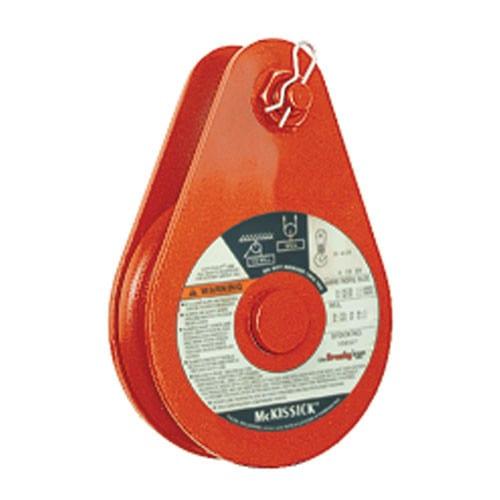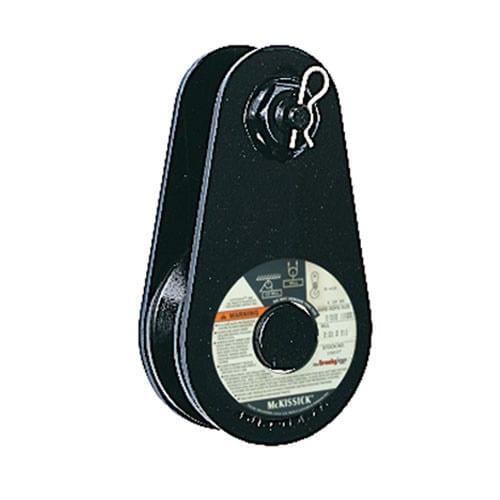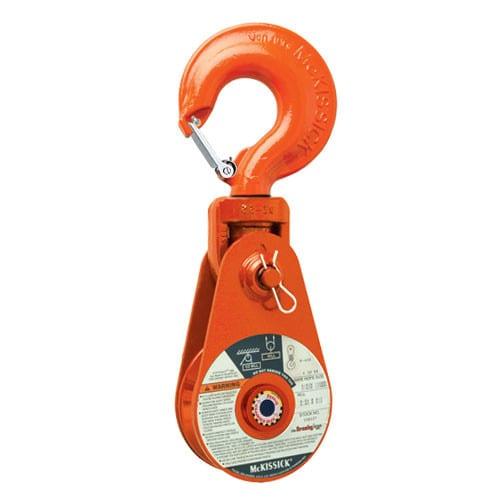
Crosby 416 BB Alloy Snatch Block with Hook
In Stock 3 sizes available
Crosby 416 6" BB Alloy Snatch Block w/ Hook - 12 Ton WLL - #193427
SKU: CR-193427
Reply within 24 hours. Formal quotation within 48 hours. Supplying since 1977.
Call +91 93729 19606(Mon to Sat, 9 am to 6 pm IST)
All sizes (3)
All sizes as a PDF| Size | WLL | SKU | |
|---|---|---|---|
| 6" | 12 t | CR-193427 | |
| 8" | 12 t | CR-193490 | |
| 10" | 12 t | CR-193613 |
Pricing for registered businesses
Sign in to view live prices, or register free — approval usually within 1 business day.
Test certificate with every supply
In-house 1,200 T test bed
Genuine Products
Request a Quote for this Product
Get a formal quotation within 48 hours.
Overview
Crosby 416 BB Alloy Snatch Block with Hook, working load limit 12 t, 3 sizes.
Full Description
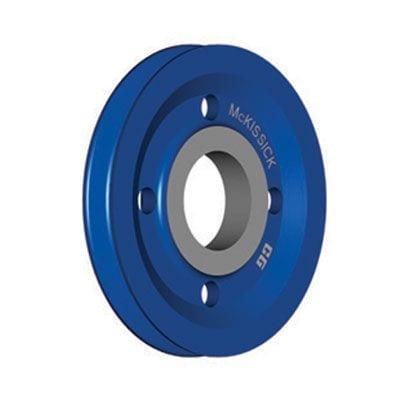
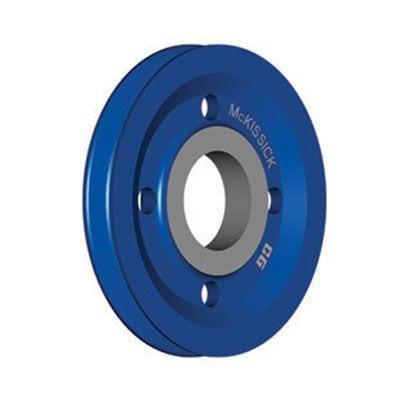
All alloy construction--entire block is made from heat-treated alloy steel which results in a 40% weight reduction when compared to blocks of comparable capacities
Lighter and stronger at the same time
Latch kit included
Roller bearing
Pressure lube fitting for sheave
Fatigue rated
RFID equipped
Prices, stock and lead times on request. Every item can be supplied with a test certificate; proof-load testing in our own test house on request.
Working with a snatch block
A snatch block changes the direction of a wire rope line, or adds mechanical advantage when it is reeved into a tackle. Its side plate opens, so the rope can be laid into the sheave at any point along its length without threading the end through. That is why snatch blocks are the standard fitting for winch and tugger lines, gin poles and temporary lead-offs on site.
The load on the block is not the line pull. It depends on the angle between the lead line and the load line. When the two lines run parallel, the block, its head fitting and its anchor point carry close to twice the line pull, and the load falls as the angle between the lines opens. Size the block, and whatever it hangs from, for that resultant load, not for the winch rating alone.
Choosing the right one
- Sheave groove matched to the rope diameter. Too tight pinches the rope and too wide lets it flatten; both shorten rope life.
- Head fitting to suit the rig: hook for quick rigging, shackle where the block must stay put, swivel eye, or a tail board for a block fixed to a structure.
- Bronze bushing (BB) sheaves for occasional use; roller bearing (RB) sheaves for frequent turning under load.
- Working load limit that covers the resultant load at the tightest angle the line will run through.
Check before every use
- Sheave turns freely, with no cracks, chips or groove worn to the pattern of the rope.
- Side plates straight, and the opening plate locks fully closed.
- Hook latch, shackle pin or swivel present, undamaged and seated.
- Sheave greased through its lube fitting on the maker’s schedule.
Ratings, dimensions and limits for this exact item come from the maker’s data shown on this page.