Webbing Sling Selection Guide: Capacity, Type and Configuration
Selecting a webbing sling means matching four things: the rated capacity (read from the sewn-in label and colour code), the sling type (endless, eyed, or fitted with hooks), the hitch (vertical, choke or basket — each changes usable capacity), and the working angle. Get all four right, add edge protection, and the sling will serve safely for years.
Choosing the right webbing sling for your lifting operation is not just about matching the weight — it involves understanding the sling type, colour-coded ratings, hitch configurations and angle effects on capacity. Polyester webbing slings manufactured to EN 1492 are the most widely used synthetic lifting slings in India and worldwide, prized for their flexibility, light weight and built-in safety margin. In India the corresponding product standard is IS 15041, covering flat woven webbing slings made of man-made fibre.
EN 1492 Colour Code — Capacity at a Glance
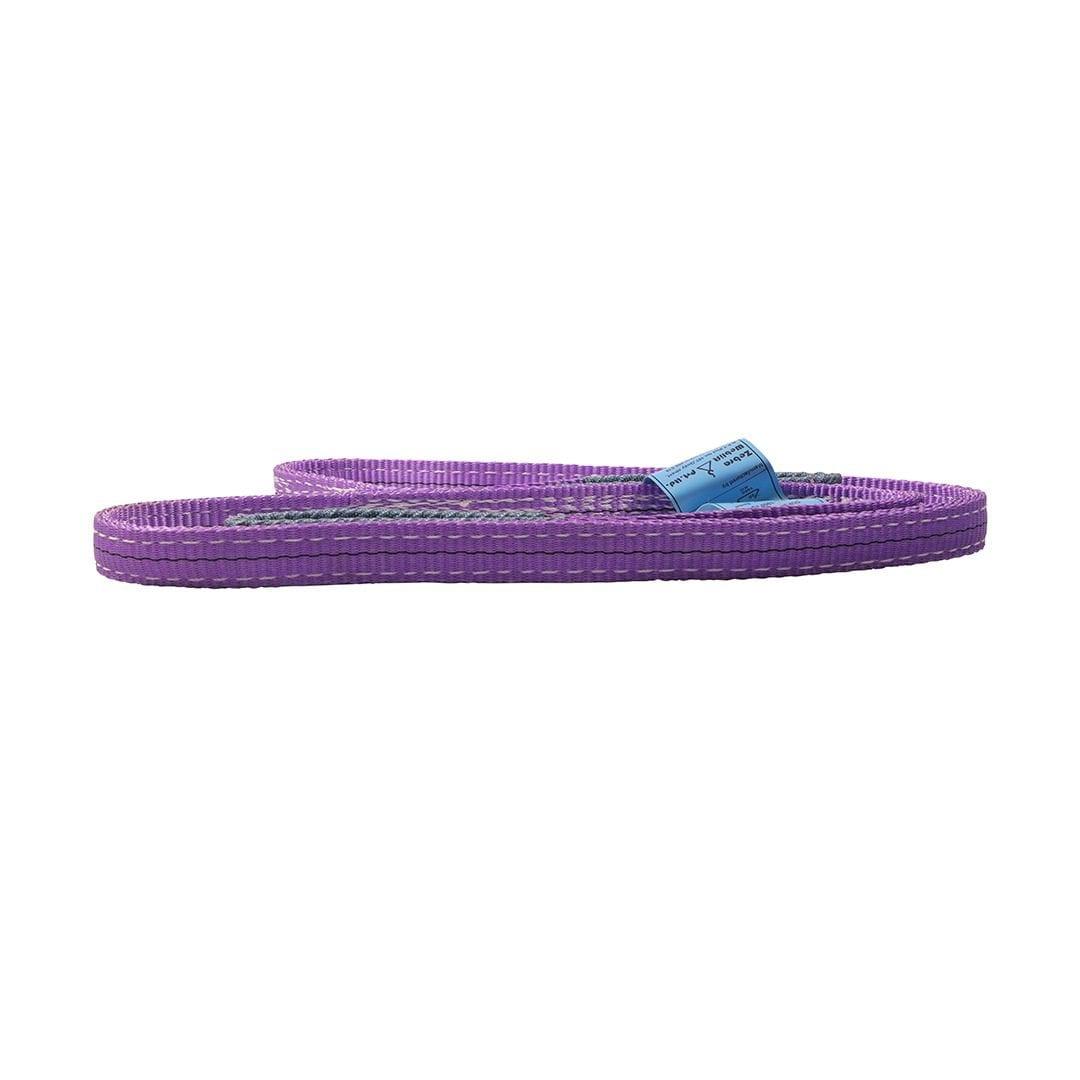
EN 1492-1 specifies a colour-coded label woven into every flat webbing sling, and EN 1492-2 applies the same coding to roundslings. The colour tells you the rated Working Load Limit (WLL) for a single-leg, vertical lift:
| Colour | WLL (single leg, vertical) |
|---|---|
| Violet | 1 tonne |
| Green | 2 tonnes |
| Yellow | 3 tonnes |
| Grey | 4 tonnes |
| Red | 5 tonnes |
| Brown | 6 tonnes |
| Blue | 8 tonnes |
| Orange | 10 tonnes and above |
These are the EN 1492-1 colour codes. From 10 tonnes up every sling is orange, so the WLL printed on the label is what tells them apart. The colour band runs along one edge of the sling and is permanent — it cannot be accidentally removed or altered. This is a real advantage over a painted or tagged marking. A sling without a legible colour band or manufacturer tag should be removed from service immediately. If the WLL/SWL terminology on labels is unfamiliar, our WLL vs SWL guide covers what the rating does — and does not — promise.
Polyester webbing slings carry a built-in safety factor of 7:1 — meaning the sling breaks at 7 times its rated working load limit. This is the highest safety factor of any common sling material, reflecting the fact that webbing is more sensitive to cuts, abrasion and UV damage than steel or chain.
Webbing Sling Types
- Endless (Circular) Slings: The webbing forms a continuous loop with a spiral-stitched seam. No metal terminations means the load is evenly distributed and there is nothing to snag. Strongest configuration — rated at the full capacity shown on the label, and safe to splice over a load without reducing capacity.
- Sling with Eyes: Loop eyes are formed at each end, usually with a flat over-and-over stitch. The eye construction reduces capacity compared to an endless sling of the same band width, but it allows connections through shackles, hooks or rings.
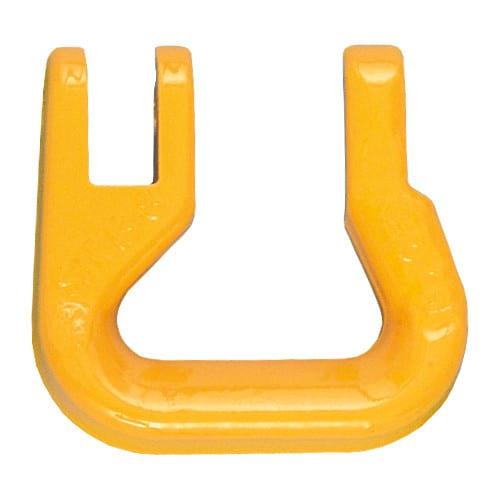
- Sling with Hooks: Pre-assembled with grab hooks (straight, angle or swivel) attached to the eye ends using a safety pin or chain link. Most convenient for repetitive lifts but add weight and require inspection of the hooks and connecting links.
- Single Leg with Eye: A single-length band with one looped eye and one cut end, used where only one attachment point is needed or as a replacement leg in a multi-leg chain sling.
Where eyes connect to hardware, use a bow shackle sized so the eye seats on the bow without bunching — our bow vs D-shackle guide explains why the wide-bodied shackle is the right partner for soft sling eyes.
Hitch Types and Their Effect on Capacity
How the sling wraps around the load fundamentally changes the capacity. EN 1492-1 assigns a mode factor to each hitch type, applied to the vertical rating:
| Hitch Type | Description | Capacity Factor |
|---|---|---|
| Vertical (Straight) | Single leg pulling straight up | 100% of rated WLL |
| Choke Hitch | Sling passes through its own eye, tightening around the load | 80% of rated WLL (mode factor 0.8) |
| Basket Hitch (legs parallel) | Sling cradles the load with both legs going up | 200% of rated WLL per sling (mode factor 2.0) |
In a basket hitch, the full capacity doubles because both legs share the load. But — and this is critical — if the legs are not vertical, the angle factor applies on top. Always take the final configuration factors from the sling's own tag and chart.
Angle Effects
As sling legs spread from vertical, tension in each leg increases. See our detailed sling angle effects article for the mathematics. The practical rule: keep sling angles at 60 degrees or above from horizontal (30 degrees or less from vertical) whenever possible. Below 30 degrees from horizontal, each sling leg carries twice the vertical load component.
Edge Protection
Polyester webbing is vulnerable to sharp edges — this is the single most common cause of premature sling failure. Always use edge guards, U-channel protectors, or timber padding where the sling contacts a sharp corner. This is not optional for safety; it is mandatory in any competent lifting plan. See our Zebra sling maintenance guide for detailed inspection and care instructions.
Sling Width and Capacity
Unlike wire rope or chain, capacity in webbing is proportional to width rather than thickness. A 50mm wide band with double-layer webbing carries roughly twice the capacity of a single-layer 50mm band. The band width, combined with the number of webbing layers, determines the WLL — always verify it against the coloured sewn-in label, never estimate.
Storage and UV: Selection Includes the Time Between Lifts
Sling selection does not end when the load lands — where the sling lives between lifts decides how much of its rated life you actually get. Polyester loses strength under prolonged ultraviolet exposure, and the early damage is invisible: fading and a dry, powdery feel arrive after degradation has already begun. Store webbing slings racked off the floor in a cool, dry, ventilated place out of direct sunlight, away from heat and chemicals, and let wet slings dry naturally before racking. Slings that must work outdoors for long stretches need shorter inspection intervals and an earlier replacement plan.
No Field Repairs — Buy the Replacement, Not the Patch
A webbing sling's stitching is its engineered, tested, load-bearing structure. No site-level repair — stitching, patching, taping, or knotting a damaged section out of the load path — restores any part of the rated capacity, and a knot in a sling drastically reduces its strength. Repairs, where the manufacturer offers them at all, are factory operations followed by re-test and re-certification. Factor this into selection: webbing is cheap enough per tonne of capacity that replacement, not repair, is always the answer. A damaged sling is withdrawn, cut up so it cannot creep back into service, and replaced.
Webbing Slings on Indian Ports and Sites
For Indian buyers the compliance picture is straightforward. IS 15041 is the Indian Standard for flat woven webbing slings of man-made fibre; EN 1492-1 (flat webbing) and EN 1492-2 (roundslings) are the marks most commonly found on the product itself; ASME B30.9 appears on specifications written to American practice. At ports, webbing slings are loose gear under the Dock Workers (Safety, Health and Welfare) Act 1986 and the 1990 Regulations: they must be periodically examined by a competent person — for dock work, one recognised by DGFASLI as Chief Inspector of Dock Safety — carry traceable identification, and appear in the statutory register. In a factory the same sling is lifting tackle under section 29 of the Factories Act 1948, thoroughly examined by a competent person at least once in every twelve months; there the competent person is recognised by the state Chief Inspector of Factories. Port duty is also close to a worst-case environment for webbing — salt-laden sun on open lay-down areas, steel coil and container edges, multi-shift usage — which is why stevedoring slings are typically specified conservatively, run with mandatory edge protection, and examined more frequently than plant slings.
Sealinkers has supplied and certified synthetic slings from Darukhana, Mumbai since 1977, and with our in-house test house and its 1,200 T proof-load test bed we also test what we sell — our sister company Zebra Weblift manufactures the webbing and round slings in our range. The pattern across hundreds of examinations: sites that select by the full four-step logic — capacity, type, hitch, angle — and store slings on racks bring them back for routine re-certification; sites that select by "colour looks right" bring them back cut, sunburnt, or not at all.
Selection Checklist
- Establish the load weight from documents or measurement — never by eye.
- Choose the sling type: endless for maximum flexibility and capacity, eyes for hardware connections, hooks for repetitive lifts.
- Apply the hitch factor (vertical / choke / basket) from the sling's own chart.
- Apply the angle factor for the real rigging geometry, and keep legs at 60° or steeper.
- Verify the label: WLL, standard, manufacturer, and serial number traceable to a certificate.
- Specify edge protection with the sling, not as an afterthought.
- Plan storage (racked, dry, shaded) and the examination schedule before the sling enters service.
- For port or outdoor duty, size conservatively and shorten inspection intervals.
Never lift on a webbing sling with a missing or illegible label, cuts, pulled stitching, heat glazing or chemical damage — and never repair, knot or shorten a sling in the field. Rated capacity applies only to an undamaged sling in the configuration shown on its chart; anything else is an unknown quantity carrying your load.
Frequently asked questions
Which webbing sling type should I default to?
If the lift allows it, an endless sling — it carries the full labelled capacity, distributes wear, and has no fittings to inspect. Choose eyed slings when you must connect to shackles or hooks, and hook-fitted slings only where repetitive identical lifts justify the added weight and inspection burden.
Can I use a webbing sling in a choke hitch at its full labelled WLL?
No — under EN 1492-1 a choke hitch delivers 80% of the labelled vertical rating (mode factor 0.8), because the choke point bends and pinches the webbing. If the choked capacity is marginal for your load, move up a size or switch to a basket hitch with proper leg angles rather than accepting a thin margin.
How do I choose between webbing slings and roundslings?
Both are EN 1492 polyester products with the same care rules. Flat webbing offers a wide, load-friendly bearing surface for painted or delicate finishes; roundslings are more compact for their capacity and suit higher tonnages. For fragile finishes at moderate weights, flat webbing is usually the kinder choice.
Is a webbing sling suitable for lifting near heat or hot work?
No — weld spatter, hot surfaces and radiant heat all damage synthetic fibre, and heat glazing can hide deeper harm. Keep webbing away from hot processes; where lifts near heat are unavoidable, chain slings are the appropriate family, and the webbing stays on the rack.
What paperwork should come with a new webbing sling in India?
A certificate of conformity identifying the sling by serial number, its standard (IS 15041 / EN 1492) and its rated WLL — and, once in service at a port or factory, entries in the statutory register backed by periodic competent-person examination. The label on the sling and the paper behind it are one system.
Ready to specify? Browse the Zebra polyester webbing and round sling range and the Zebra Weblift brand page, and pair your slings with certified shackles — or contact Sealinkers and our Mumbai team will size the sling, the hitch and the hardware for your lift.
Related Guides
Ready to put this into practice?
Every item ships certified, and our in-house test house backs it with the paperwork.
Sealinkers Engineering
Rigging & Lifting Engineering Team
Sealinkers has supplied and certified rigging, lifting and mooring equipment from Darukhana, Mumbai since 1977. These guides are written and checked by the engineers who specify this gear and proof-load it on our own test bed.
- in-house test house — proof-load bed from 1 to 1,200 tonnes
- Proof-load testing and certification in-house since 1977, Darukhana, Mumbai
- Class-society interfaces: IRS, ABS, LRS and BV